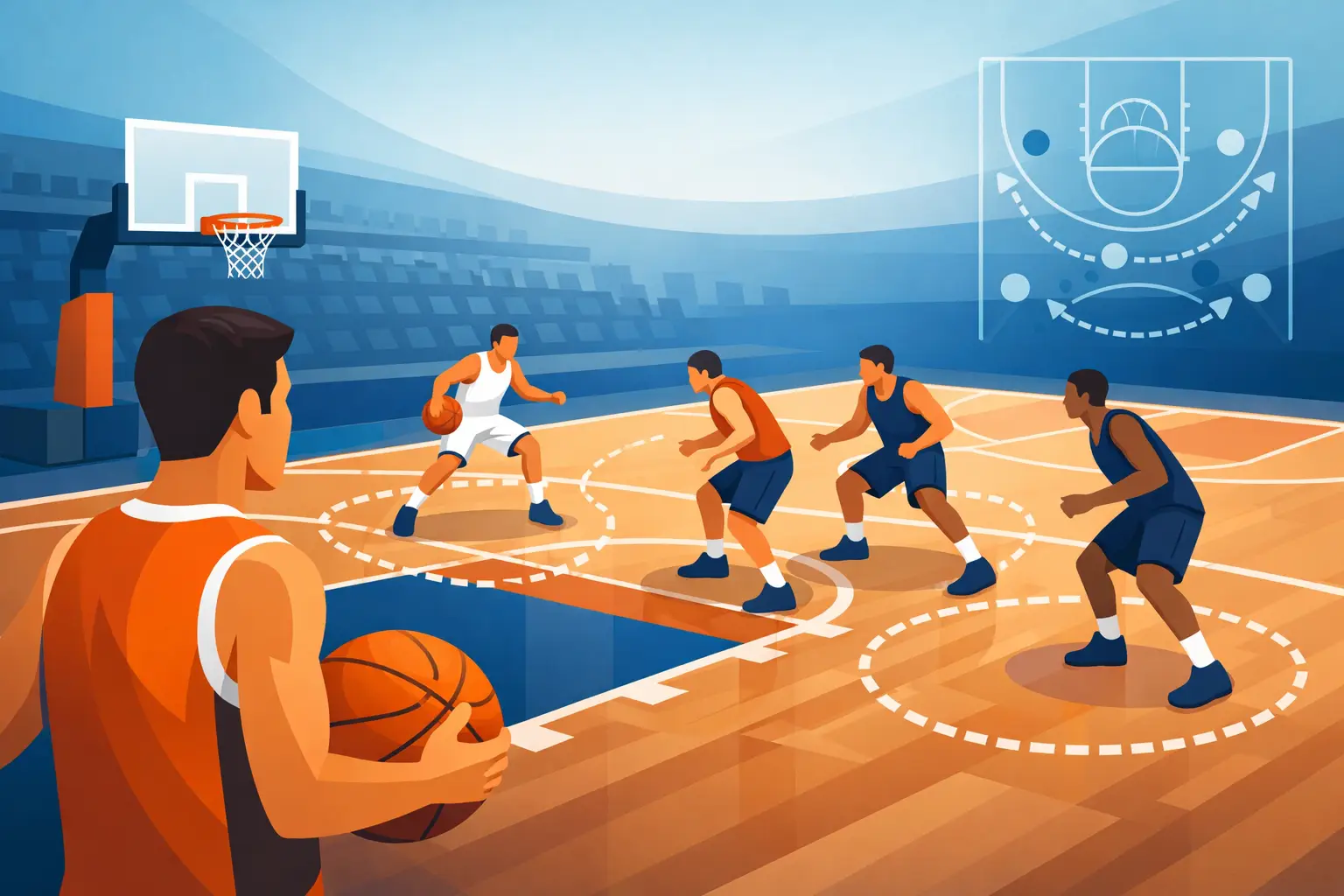
A drive that looks crowded is often not a ball-handling problem. It is a spacing problem. If you have ever wondered, what is basketball court spacing, the simplest answer is this: it is how offensive players position themselves to give the ball handler room to attack while staying available for the next pass.
Good spacing makes the defense choose. Help on the drive, and an open teammate is ready. Stay attached to shooters, and the ball handler has a clearer lane. For middle school and high school players, learning this concept can immediately improve shot quality, passing decisions, and offensive confidence.
What Is Basketball Court Spacing?
Basketball court spacing is the intentional distance and positioning between offensive players. It is not just standing far apart. Effective spacing places players where they can stretch defenders, create driving lanes, maintain passing angles, and react to what the defense does next.
Think of the court as a series of working areas: the paint, the wings, the corners, the top of the key, and the dunker spot near the baseline. When multiple offensive players occupy the same area without a reason, defenders can guard two people at once. When players fill useful areas with purpose, every defender has a harder job.
Spacing changes based on the offense, the personnel, and the situation. A team with strong shooters may spread all five players around the perimeter. A team with a dominant post player may space four players around the paint. The principle stays the same: do not make the defense’s job easier by bringing extra bodies into the same space.
Why Spacing Creates Better Decisions
Young players are often taught to move without the ball. That is valuable, but movement is not automatically good. If a player cuts directly into a teammate’s driving lane, that movement hurts the offense. If that same player lifts from the corner to the wing as a teammate drives baseline, it may create a passing window and force a defensive rotation.
Spacing gives the ball handler clearer reads. On a drive, the ball handler should be able to see three things: the rim, the help defender, and the next available pass. Poor spacing hides those answers. Good spacing makes them visible.
For example, imagine a guard driving from the top of the key to the right side. If the right corner is occupied and the right wing stays wide, the low defender must decide whether to stop the drive or stay with the corner shooter. If the defender helps, the guard can make a simple kick-out pass. If the defender stays home, the guard has a better chance to finish.
That is basketball IQ in action. The play is not about making a difficult pass. It is about recognizing that proper positioning created an easy read.
The Five Offensive Areas Players Need to Understand
Players do not need to memorize a complicated playbook before they can improve their spacing. Start by recognizing the main areas that shape most half-court offenses.
The top is where guards often initiate the offense and where reversal passes can reset an action. The wings give the offense wide passing angles and room for drives from the slot. The corners are valuable because a defender in the corner has a long distance to help and recover. The paint is where finishes, post-ups, and help defense happen. The dunker spot is the short-baseline area outside the lane, often used by a non-shooting big to stay available for a drop-off pass without clogging the middle.
The goal is not for every player to stand in one of these spots all possession. The goal is to understand what each spot does to the defense. A corner player pulls help lower. A wing player offers an outlet. A player at the dunker spot can occupy a rim protector. A player cutting through the paint can force defenders to communicate.
Spacing Is Distance, but It Is Also Timing
A common mistake is treating spacing like a freeze-frame. Players start in the right spots, then the ball moves and nobody adjusts. Now the offense is technically spread out, but the passing angles are gone and the defense has recovered.
Good spacing moves with the ball. When the ball is driven, passed, or screened for, off-ball players must reposition based on the action. This is often called moving on the airtime of the pass. Instead of catching the ball and then deciding where to go, players begin adjusting while the pass is in the air.
Drive-and-Drift
When a teammate drives toward your side of the court, drifting toward open space can keep you in the passer’s vision. If a player drives from the top toward the right wing, the right-corner player may slide deeper or wider along the baseline. That small adjustment keeps the corner pass open and makes the helper travel farther to recover.
Drive-and-Lift
If a teammate drives baseline, a player on the weak-side corner may lift toward the wing. Why? The defender helping at the rim may leave that passing window open. Lifting gives the ball handler a cleaner angle for a kick-out pass.
Fill Behind the Drive
When a ball handler drives from the top, the player nearest the vacated area may fill behind the drive. This gives the ball handler a safety outlet if the defense cuts off the lane. It also prevents the offense from becoming bunched up on one side of the floor.
These reactions are not random. They are habits built through repetition, film study, and live decision-making.
What Poor Basketball Court Spacing Looks Like
Poor spacing usually shows up before the turnover or forced shot. Watch for players standing too close together on the perimeter, cutting into the paint while a teammate is driving, or following the ball instead of filling an open area.
Another common issue is a player who stays close to the ball because they want to be involved. The intention is understandable, but stepping toward the ball can bring your defender directly into the action. Sometimes the best way to help your teammate is to stay wide, hold your defender, and be ready when the pass comes.
Bigs can affect spacing just as much as guards. A post player who stands in the middle of the lane while a guard drives removes the guard’s finishing space. But that same player can become valuable by setting a screen, sealing a defender, relocating to the dunker spot, or stepping into open space for a short-roll catch.
Spacing also depends on shooting ability. If defenders do not respect a perimeter shooter, that player’s defender may help off and clog the lane. The answer is not always to stand farther away. It may mean screening, cutting, relocating, or finding a better role within the action. Good offenses account for the players on the floor.
How Players Can Improve Spacing in Games
Start with one question every time a teammate has the ball: Am I helping create a clear advantage, or am I bringing my defender closer to the action? That question can change your off-ball habits quickly.
When you watch film, do not only follow the player who scores. Pause before the drive and study the four players without the ball. Who stayed in the corner? Who lifted into a passing window? Who cut at the wrong time? Who forced a defender to make a difficult choice?
In practice, use simple constraints. During a scrimmage, a coach can stop the action whenever two offensive players are in the same space without a purpose. Players can also play small-sided games, such as three-on-three or four-on-four, where every cut, relocation, and passing angle is easier to see.
For parents, the best questions after a game are not always about points. Ask your athlete, “Where was the help defender on your drive?” or “What did you see when your teammate cut?” These questions help players connect their positioning to the decisions that followed.
At C-Buckets Hoops IQ Lab, this is the kind of detail film study can make clear. Players begin to see that smart offense is not only about who has the ball. It is about how all five players create an advantage together.
Spacing Does Not Mean Standing Still
The strongest offenses balance discipline with activity. Players maintain useful distance, then move with purpose when the defense shifts. A cut should create an opening. A screen should force a coverage decision. A relocation should improve a passing angle.
Before your next game, pick one spacing habit to focus on. Maybe it is staying in the corner when a teammate drives middle. Maybe it is lifting from the corner on a baseline drive. Maybe it is filling behind penetration instead of watching the play. Small adjustments like these turn crowded possessions into clear reads – and clear reads lead to better basketball.
Leave a Reply