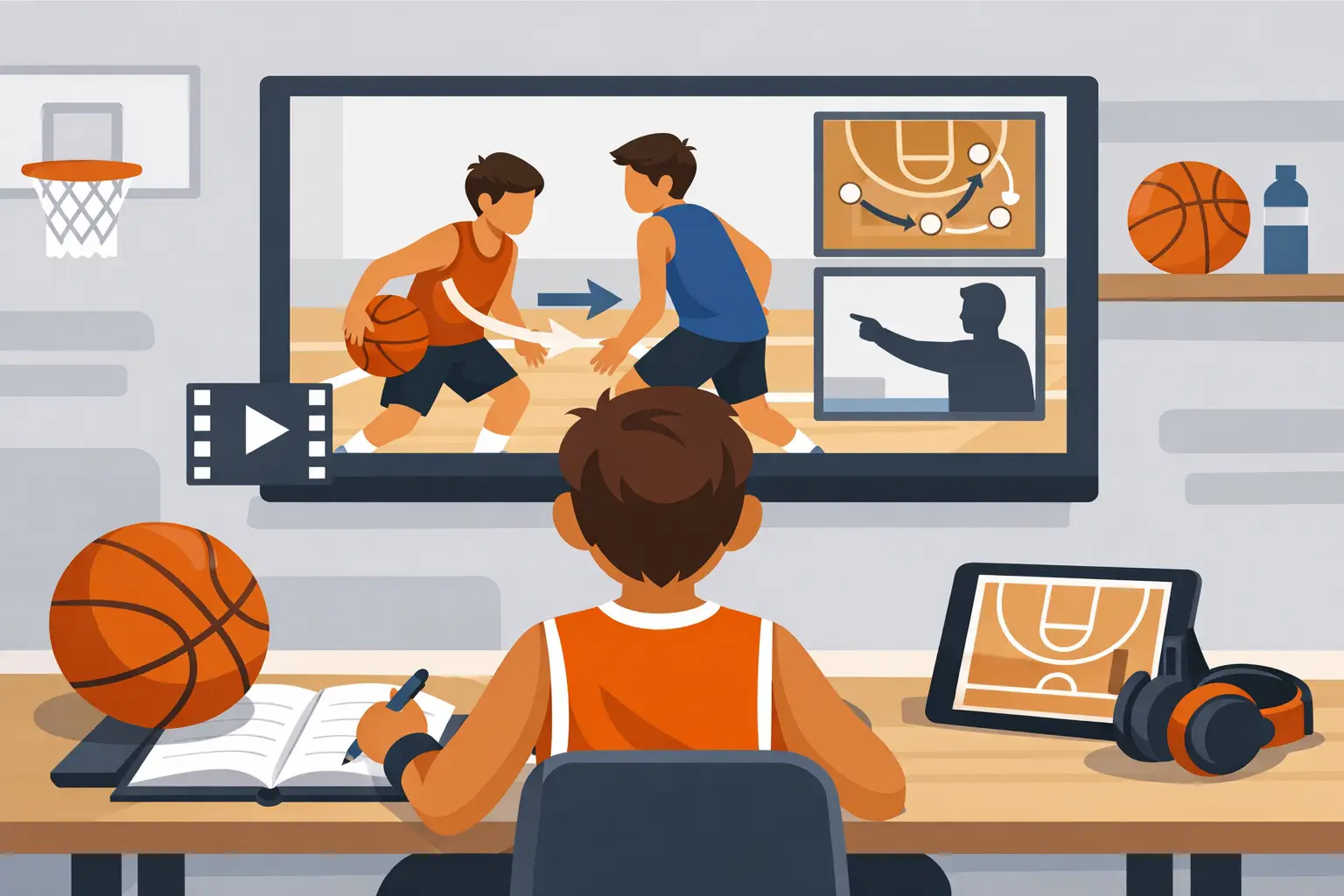
The possession that feels confusing on Saturday can become a clear read by Monday. That is the purpose of a youth basketball film study routine: not to replay every mistake, but to help a player recognize the next similar situation faster. For middle and high school athletes, film turns coaching phrases like “keep your spacing” and “make the simple read” into pictures they can recognize under pressure.
The best routine is short enough to repeat, specific enough to teach one idea, and connected directly to the player’s next practice or game. A player does not need to watch an entire 32-minute game to get better. In fact, long, unfocused viewing often creates the opposite result. The athlete remembers a missed shot, feels frustrated, and misses the decision that created the shot.
Start With One Game Question
Every film session should begin with a question. Not a broad question such as, “What did I do wrong?” Use a question tied to a real game situation: “When my defender helped from the wing, did I see the open teammate?” “Was I spaced correctly when the ball drove middle?” “What did I do after making a pass?”
One question gives the player a filter. Without it, film can become entertainment or self-criticism. With it, the player learns to scan for a pattern.
For a guard, the weekly question might center on ball-screen reads: Did the screen create a driving lane, a pocket pass, or a skip pass? For a wing, it may be about off-ball movement: When the ball was driven from the opposite side, did I drift into the right passing window? For a post player, it could be about sealing: Did I establish position before the entry pass, or did I wait until the ball was already there?
Parents can help by asking what the player is studying before the video starts. Avoid jumping straight to points, turnovers, or playing time. The better question is, “What read are you looking for today?” That keeps the conversation focused on learning instead of judgment.
Keep the Youth Basketball Film Study Routine Short
For most young players, 15 to 25 focused minutes is enough. The goal is repeatable learning, not a marathon session after every game. Two short sessions per week will usually produce more growth than one hour of passive watching.
A practical routine has three parts. First, watch the clip once at full speed without stopping. This lets the player experience the pace and see the possession as it happened. Next, watch it again and pause before the decision. Ask what options are available before revealing the outcome. Then watch a final time and name the lesson in one clear sentence.
For example: “When the low defender steps up to stop my drive, the weak-side wing is open if our spacing stays wide.” That sentence is more useful than, “I should have passed sooner.” It identifies the defender, the trigger, the teammate, and the spacing required for the pass to exist.
Short sessions also protect a player from information overload. A ninth grader may understand five different mistakes after watching one game, but trying to fix all five at once usually changes nothing. Choose the one read that appears most often or has the biggest impact on the team’s offense.
Watch Decisions Before Results
Young players naturally judge a possession by whether the shot went in. Coaches and high-level players know that the quality of the decision matters first. A missed open three can still be the right play. A made contested layup can still be a poor read that will not hold up against better competition.
When studying film, pause before the pass, shot, or drive. Ask these three questions in order: What was the defense taking away? What space did that create? What was the simplest available play?
This sequence teaches players to read the defense instead of memorizing a script. If the defense goes under a ball screen, a capable shooter may have room to shoot. If the on-ball defender fights over and the big drops back, the ball handler may have a pocket pass or pull-up window. If the help defender tags the roll player, the weak-side shooter may be available. The correct answer depends on personnel, score, time, and team rules, but the read always begins with what the defense shows.
This is also where parents can see why a player’s stat line never tells the full story. An athlete may finish with only six points but make the extra pass, hold correct spacing, and create clean looks for teammates all game. Those are winning actions. Film makes them visible.
Study Your Team’s Spacing, Not Just Your Own Moves
Many youth players watch film looking only for their own dribbles, shots, and turnovers. That is understandable, but it limits growth. Basketball is a five-player game, and spacing determines whether many reads are available at all.
When the ball is driven, look at the players away from it. Is someone standing too close to the driver? Is the corner filled? Did a cutter clear through the lane, or did two teammates occupy the same space? Is there a safety outlet behind the ball?
A player who understands spacing can contribute even on possessions where they never touch the ball. A properly spaced wing forces a defender to make a choice. A timely cut can pull help away from the rim. A player who replaces behind penetration gives the ball handler an outlet instead of leaving them trapped.
Do not treat spacing as standing still. Good spacing adjusts as the ball moves. On film, notice what happens immediately after a drive, pass, or cut. That is often where the next advantage is created or lost.
Turn Each Session Into One Practice Cue
Film only matters if it changes live behavior. At the end of every session, the player should choose one cue to carry into practice. Keep it short enough to remember in transition, when tired, and when the game speeds up.
A guard might use, “Eyes to the low defender.” A wing might use, “Drift on baseline drives.” A post player might use, “Hit first, then show hands.” The cue is not a complete scouting report. It is a reminder that connects the film lesson to an action.
The next practice is where the player tests the cue. They should not expect perfection immediately. The first win may simply be noticing the situation earlier. The second win may be making the right read in a drill. Eventually, the read carries into a game without conscious effort. That progression is how basketball IQ is built.
If a coach has a different terminology or a specific team rule, use the coach’s language. Film study should support the system the player is in, not create competing instructions. A player can learn universal concepts like help defense and spacing while still following the offensive rules of their school or club team.
Use Mistakes Without Letting Them Take Over
Film can be uncomfortable because it is honest. A missed rotation, forced drive, or late closeout is hard to deny when it is on screen. But effective study is not about proving a player failed. It is about locating the moment where a better decision was available.
After a mistake, avoid stopping at “I messed up.” Go one level deeper. What did the player fail to see? Were their eyes on the ball too long? Did they not recognize help? Were they out of position before the action began? Did fatigue, communication, or a rushed pace affect the decision?
Then compare that possession with one positive example. If possible, find a similar action where the player made the correct read. The contrast teaches faster than criticism alone. It shows that the player is capable of the solution and needs repetition, not a complete rebuild.
Build a Weekly Rhythm You Can Maintain
A sustainable schedule might include one session after a game to identify the main lesson and one session before the next game to review it. The first session looks backward for evidence. The second looks forward with a purpose.
If game footage is unavailable, players can still study short clips from practice or guided examples of the same situation. The key is not whose footage appears on the screen. The key is whether the player can answer: What did the defense do, what option did that create, and what should I look for next time?
Keep a simple notebook or phone note with the date, the game question, one clip lesson, and the practice cue. Over several weeks, the notes reveal patterns. Maybe the player consistently misses weak-side help. Maybe they improve quickly as a cutter but need work reading ball screens. That record gives training direction instead of relying on vague feelings after a game.
The player who watches film with a purpose starts seeing possessions before they fully happen. That is the edge worth building: calmer decisions, better spacing, and a clearer answer when the game asks, “What do you see?”
Leave a Reply