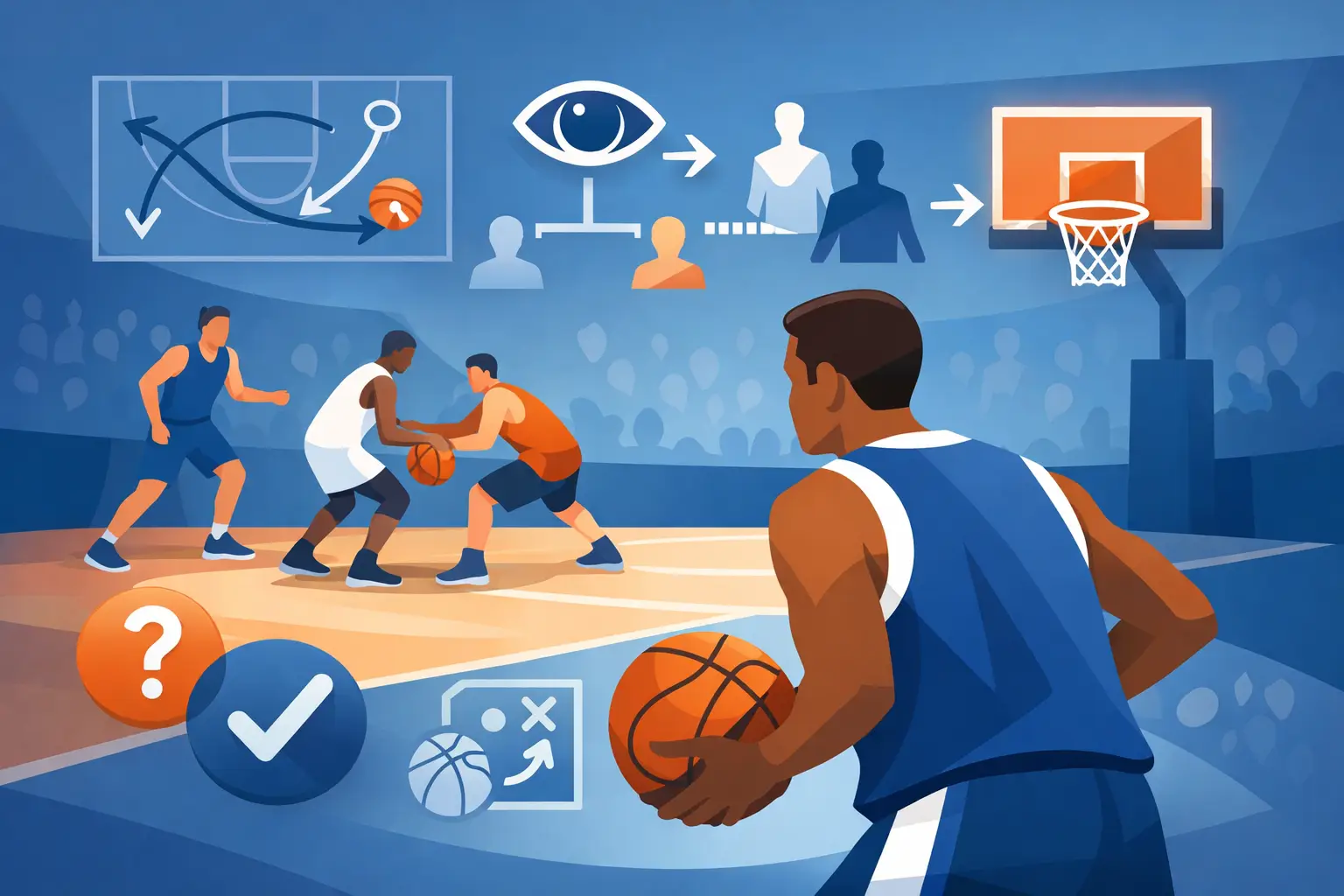
A defender stunts at the ball, your teammate lifts from the corner, and the lane opens for half a second. The player who sees that sequence early creates an easy shot. The player who waits until the lane is fully open is usually passing into traffic. That is the real answer to how to make better reads in basketball: learn to recognize what is about to happen, not just react to what already happened.
Better reads are not reserved for point guards or older players. Every player has decisions to make: whether to shoot, drive, cut, screen, relocate, help, or stay home. Basketball IQ is the ability to connect what you see with the right action quickly enough for it to matter.
Better Reads in Basketball Start Before the Catch
Many young players catch the ball first, then begin looking around. That puts them behind the play. A better habit is to scan before the ball arrives.
As the pass is traveling, check your defender, the nearest help defender, and your teammates’ spacing. Is your defender closing out long? Is a teammate cutting into your driving lane? Is the low defender already standing in the paint? Those details tell you what your first option should be before the catch reaches your hands.
This does not mean deciding you will shoot before you receive the pass. It means arriving ready to make a decision. If the defender is late, shoot with confidence. If the closeout is hard, attack the defender’s top foot and read the help. If the defense is loaded to your side, move the ball quickly instead of forcing a contested drive.
Players who look prepared often seem faster than everyone else. Usually, they are not moving faster. They are processing earlier.
Read the Defender Who Can Stop the Play
A common mistake is watching only the defender directly in front of you. Your on-ball defender matters, but the next defender often determines the correct play.
When you drive, identify the low help defender. In many youth games, that player is responsible for protecting the rim. If they stay attached to the corner shooter, you may have a clear finish. If they step into the lane early, the corner pass may be open. If they help from the wing, the wing teammate may be available for a catch-and-shoot opportunity or one more pass.
The key is to read the help defender’s body and feet. A defender with both feet in the paint is committed to helping at the rim. A defender who is one step toward the ball but still facing their matchup may be trying to stunt and recover. Those are different situations, so they require different answers.
Do not pass just because someone helps. Pass because the help creates an advantage. If a defender takes away your teammate but leaves the rim open, finish. If they fully commit to you and abandon a shooter, make the simple pass on time.
Spacing Makes the Read Clearer
Good spacing does not just make an offense look organized. It gives the ball-handler cleaner information.
When two offensive players stand too close together, one defender can guard both of them. That shrinks driving lanes and makes passing windows disappear. When teammates fill the corners, wings, slots, and dunker spot with purpose, help defense has to travel farther. A longer help rotation creates more time for the offense to read and react.
For players without the ball, spacing is also a decision-making responsibility. If your teammate drives toward you, do not stand in the same lane and bring your defender to the ball. Lift, drift, or relocate based on where the drive is coming from. A baseline drive often calls for the weak-side corner player to drift along the baseline. A middle drive may call for a teammate to slide into the open window behind the ball-handler.
The exact movement depends on your team’s offense and your coach’s rules. But the principle stays the same: move to create a clear passing angle, not simply because you feel like moving.
Use Your Defender’s Position as a Clue
Every defender is giving you information. The question is whether you recognize it early enough.
If your defender is top-side denying a wing entry, a back cut may be available. If they are sitting well below the three-point line, they are inviting a shot and taking away the drive. If they turn their head to watch the ball, they may lose sight of you for a cut. If they trail over a screen, a curl or drive may be open. If they go under, the ball-handler may have space for a shot or a re-screen.
Young players sometimes memorize these as automatic rules: defender denies, back cut; defender goes under, shoot. Those are useful starting points, but basketball is not a worksheet. You still need to see the rest of the floor. A back cut is less valuable if the passer is heavily pressured. A pull-up is not the best choice if a rim protector is waiting and a teammate is wide open.
The best reads come from recognizing the first clue, then confirming it with the next piece of information.
Slow Down Your Eyes, Not Your Game
Players often hear “play faster” and assume it means rushing. Rushing leads to jump passes, picked-up dribbles, and decisions made without seeing the defense. Smart players play fast because their eyes are calm.
Give yourself a simple visual sequence. Before the catch, locate your defender and the help. On the catch, see the closeout. On the drive, locate the low defender. As you get near the paint, find the open teammate created by that defender’s help.
You will not see every player on every possession. You do not need to. You need to see the players connected to your decision.
This is especially important in transition. Before pushing the ball into a crowd, look ahead. Where is the rim protector? Is your wing filling the lane wide? Is a defender backpedaling between two offensive players? A two-on-one is not about making a fancy pass. It is about forcing the lone defender to choose, then delivering the ball after they commit.
Practice Reads With Constraints
A player will not become a better decision-maker by only doing stationary drills. Ball handling and shooting matter, but a game read requires defenders, spacing, timing, and consequences.
In workouts, use small-sided games such as two-on-two, three-on-three, and four-on-four. Fewer players give each athlete more touches and more chances to recognize actions. Add a purpose to the drill. For example, on a drive-and-kick game, a basket only counts after the ball enters the paint and the offense makes the correct kick-out read. On a closeout drill, the defender can close short, hard, or to one side, and the offensive player must respond instead of performing a preplanned move.
At home, you can train the mental side through film. Watch one possession at a time and pause before the decision. Ask yourself: Where is the help coming from? What is the defender taking away? What would create the cleanest shot? Then watch the result. The goal is not to criticize every turnover. The goal is to build pattern recognition.
At C-Buckets Hoops IQ Lab, this is the purpose of guided film study: helping players see repeatable game patterns in a clear, age-appropriate way, then carry those patterns into practice and competition.
Review Decisions Without Judging Every Result
A made shot is not always proof of a good read. A difficult jumper can go in while an open teammate stands alone. A missed layup can still come from the right decision if the ball-handler beat the help and created a good finish.
After a game, choose three or four possessions to review. Look at the decision before you look at the outcome. Did you scan before the catch? Did you identify the help defender? Did you maintain spacing when a teammate drove? Did you make the pass before the window closed?
This approach helps players stay coachable. It replaces “I played bad” with something useful: “I missed the weak-side helper twice,” or “I was late relocating after a baseline drive.” Specific observations lead to specific improvement.
Let Repetition Build Trust
Better basketball reads do not appear because you memorize every possible coverage. They improve when you repeatedly watch the game, identify the relevant defender, and make a clear decision under live pressure.
Start with one habit in your next practice: scan before every catch. When that becomes natural, add the low-help read on every drive. Small improvements in what you see will show up as smarter passes, cleaner shots, fewer turnovers, and more confidence when the game speeds up.
Leave a Reply