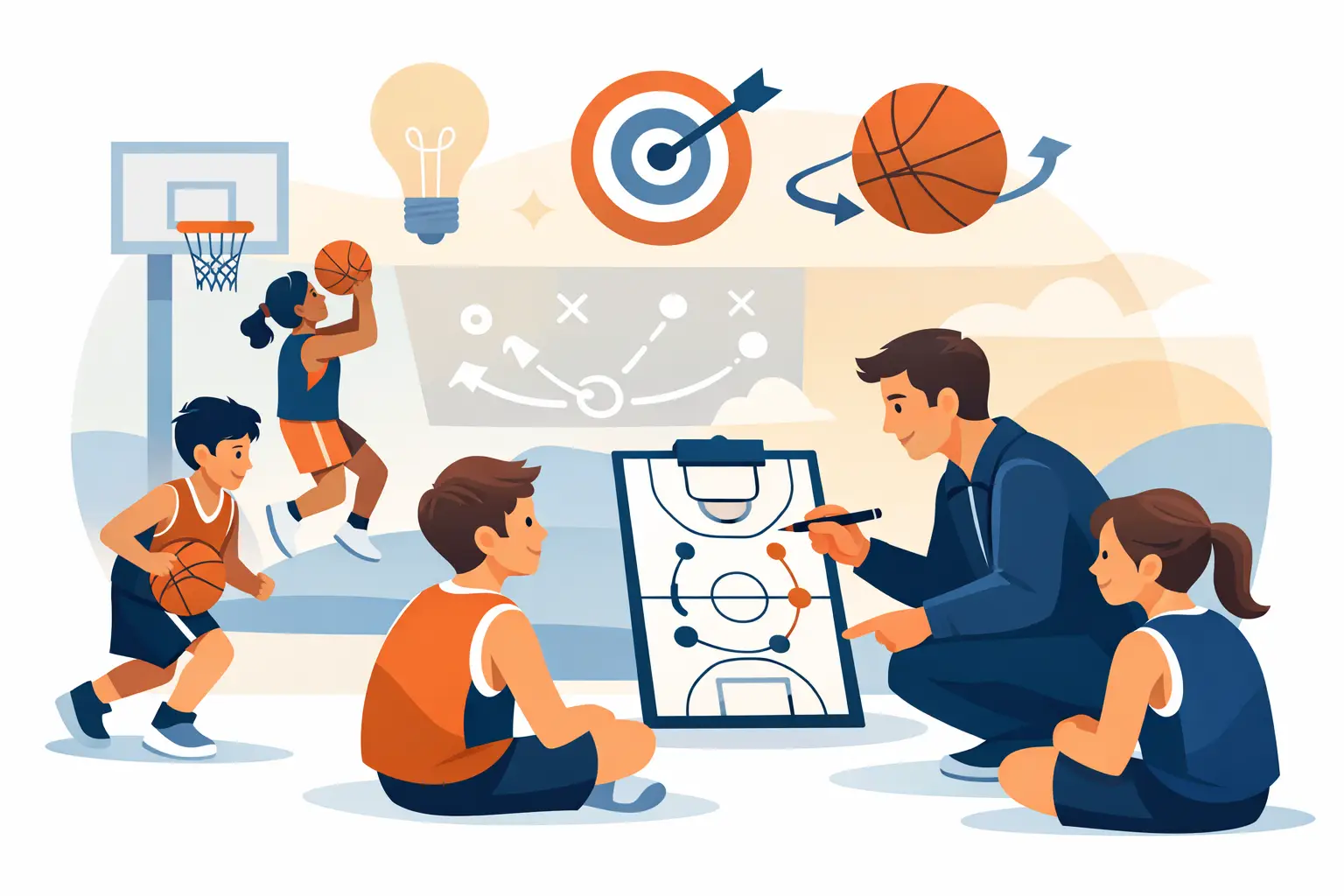
A middle school guard can make 20 shots in an empty gym and still struggle when a help defender steps into the lane. That gap is where middle school basketball IQ matters. Basketball IQ is not about memorizing a long list of plays or trying to look like a college player. It is the ability to see what is happening, recognize the important detail, and make a useful decision before the defense takes the option away.
For young players, that skill often shows up in simple moments: making the extra pass instead of forcing a layup, cutting when a teammate drives, or slowing down after a defensive rebound when the transition lane is not there. Players who improve these reads become more valuable even on nights when their shot is not falling.
What Middle School Basketball IQ Actually Means
Basketball IQ is pattern recognition under pressure. A player sees a defender turn their head, notices an open space, understands what the offense needs, and reacts with purpose. The game moves quickly, so the goal is not to stop and think through five choices. The goal is to build clear habits that make the right choice easier.
At the middle school level, the most valuable habits are usually not complicated. Players need to understand where to stand, when to move, who is guarding them, and what happens when the ball gets into the paint. Those answers change based on the situation, but the questions stay the same.
A player with growing IQ may not be the tallest, fastest, or strongest athlete on the floor. They can still impact the game by being early to the right spot, keeping proper spacing, communicating on defense, and making one clean decision after another. Coaches trust players who do not create avoidable problems for their teammates.
Skill Is the Tool, Decision-Making Is the Use of It
A crossover is useful if it creates an advantage. A pass is useful if it reaches the right teammate at the right time. A three-point shot is useful if it comes from balance, space, and a good team possession.
This is why skill training and IQ training should work together. A player needs the ability to dribble, pass, shoot, and finish. But they also need to recognize when each skill is the best answer. More moves do not automatically lead to better offense. Often, one hard drive, a jump stop, and a simple kick-out pass is the smarter play.
Start With Spacing Before Advanced Plays
Spacing is one of the fastest ways to improve middle school basketball IQ because every player can affect it without needing the ball. When teammates stand too close together, one defender can guard multiple players. Driving lanes disappear, passing angles shrink, and turnovers rise.
Teach players to create useful distance from teammates, not just random distance. If a teammate drives baseline, the weak-side players should not all run toward the rim. One player may drift to open vision for the driver, while another stays ready for a pass that keeps the defense stretched. The exact spots depend on the offense, but the principle is consistent: do not bring your defender to the ball.
Parents can watch for this in games. Instead of asking only, “Why didn’t you shoot?” ask, “Where was the open space when your teammate drove?” That question helps a player learn to see the possession, not just remember whether they scored.
Three Off-Ball Reads Every Player Should Practice
Young players do not need a playbook full of terminology to make better off-ball decisions. They need a few dependable reads they can recognize repeatedly.
When your defender is watching the ball and loses sight of you, cut with purpose. When a teammate drives toward your side, move to create a passing window instead of standing behind a defender. When the ball is on the opposite side and your defender helps into the lane, be ready to relocate into open space.
The key is timing. Cutting too early can crowd the lane. Relocating too late can make the pass impossible. Film study helps because players can pause a possession and see the moment a defender committed. Over time, they begin to recognize that moment live.
Teach Players to Read the Defense, Not Guess
Many middle school players decide what they want to do before they know what the defense is doing. They catch the ball planning to drive, shoot, or throw a certain pass. Good defenders benefit when an offensive player is predetermined.
A better habit is to scan before and after the catch. Before receiving the ball, a player should know where the basket is, where their defender is, and where help defense is coming from. After the catch, they can make a quick read: Is there space to shoot? Is the defender closing out too hard? Is a teammate open because the defense helped?
This does not mean every player should hold the ball and overthink. It means they should play with their eyes up. A quick decision is strong when it comes from a real read. A rushed decision is different. It comes from panic or habit.
On defense, the same principle applies. Players should learn to identify ball, player, and basket. They need to see whether their assignment is a shooting threat, whether the ball handler has an open lane, and whether a teammate needs help. A defender who stares only at the ball will get back-cut. A defender who watches only their player may miss a drive to the rim.
Use Film to Slow the Game Down
The best time to teach a game read is not always during a timeout or immediately after a mistake. In those moments, emotions are high and attention is limited. Film creates a calmer learning environment where a player can see the whole possession.
Short clips work especially well for middle school athletes. A 15-second clip can teach a major lesson if the player is guided to look for the right detail. Pause before the pass and ask: Where is the help defender? What would create more space? If the ball handler drives middle, which teammate is now open?
Avoid turning film into a highlight reel or a mistake session. Players need to study good possessions as closely as bad ones. Show a clean defensive rotation. Show a player sprinting into proper spacing. Show a simple extra pass that produces an open shot. Those examples make basketball intelligence feel repeatable, not mysterious.
C-Buckets Hoops IQ Lab uses this kind of guided film approach because players learn faster when advanced game concepts are broken into clear, age-appropriate reads they can take into practice.
A Simple Film Routine for Players and Parents
One or two clips after a game can be enough when the focus is specific. Choose a possession involving one decision, then let the player explain what they saw before offering an answer. This builds ownership and reveals whether the issue was awareness, technique, or execution.
Use four questions consistently:
- What was the game situation?
- Where was the defense helping from?
- What space was available?
- What was the best next decision?
The goal is not to prove a player wrong. The goal is to train their eyes. If a player can explain a missed read after watching film, they are closer to recognizing it the next time it happens.
Transfer the Lesson to Practice
Film without court application becomes information. Court work without understanding can become repetition without purpose. Players need both.
After studying a clip, give the player one game-like focus for practice. It might be: “On every drive, find the help defender before you leave your feet.” It could be: “When you are one pass away, stay spaced and ready for the kick-out.” Keep the focus narrow enough that the player can remember it while moving.
Small-sided games are especially useful for decision-making. In 3-on-3, players get more touches, more spacing situations, and more chances to see help defense. Coaches can set a rule that rewards paint touches followed by an extra pass, or pause a possession when the spacing collapses and let players reset it. The lesson becomes visible immediately.
There is a trade-off here. Too many rules can make practice feel robotic. Too few teaching points can allow bad habits to repeat. The best balance is one clear emphasis, plenty of live reps, and quick feedback tied to what the player actually saw.
Measure Growth Beyond Points
A player can score 12 points and still force shots, miss open teammates, or lose track of assignments. Another player may score four points but make winning plays all game. For middle school athletes, growth should include both production and decision quality.
Watch for signs that a player is improving: fewer rushed turnovers, better positioning before the ball arrives, stronger defensive communication, more purposeful cuts, and better responses after a mistake. These changes may not all show in a box score, but coaches notice them.
Parents can support this process by praising the read, not only the result. If a player makes the right pass and a teammate misses the shot, the decision was still good. When young athletes learn that smart basketball is valued, they are more willing to make the extra pass and trust the offense.
The next game, choose one possession to study rather than judging every shot or turnover. Ask your player what they saw, then help them find one read to carry into practice. That small habit can change how they see the floor.
Leave a Reply