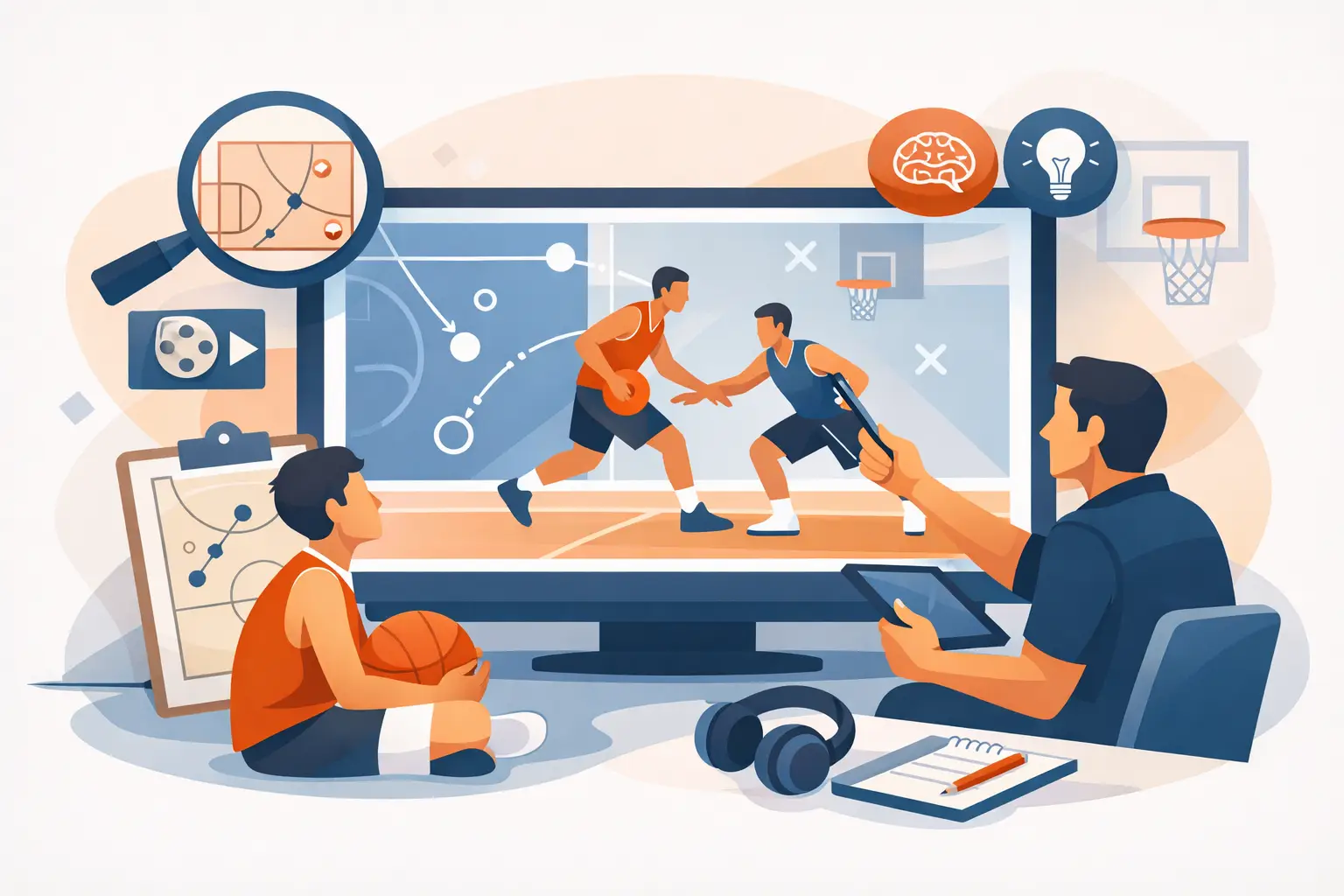
A guard comes off a ball screen, gets two feet in the paint, and still throws a pass straight into the weak-side tag defender. Most young players think the mistake was the pass. Usually, the mistake happened two seconds earlier. That is why youth basketball film breakdown matters. It teaches players to see the possession before the turnover, not just react to the result after it happens.
A lot of training for middle school and high school players still focuses on visible skills. Handle. Shooting form. Footwork. Those things matter. But game performance is not just about what a player can do in an empty gym. It is about what they can recognize under pressure, with defenders moving, spacing changing, and time shrinking. Film breakdown trains that layer of the game.
What youth basketball film breakdown actually teaches
At its best, film study is not a replay session where someone says, “good shot” or “bad turnover.” That kind of commentary does not improve decision-making. A real youth basketball film breakdown teaches players how to identify patterns.
That starts with spacing. Where are the corners? Is the dunker spot occupied? Did the screener roll into traffic because the lane was already crowded? Young players often think a play failed because somebody missed a shot. On film, you can see that the possession was already compromised because the floor was too tight or the timing was off.
It also teaches reads. On a drive, is the low defender helping early or staying home? Against a ball screen, is the defense dropping, switching, or hedging? On a catch, is there an immediate advantage or should the ball move? Players who improve here do not just look more polished. They play faster without rushing because they know what they are seeing.
Then there is game context. Score, time, foul situation, matchup, transition balance – these details shape the right decision. A tough pull-up jumper might be a poor shot in the first quarter and the correct shot late in the clock. Film helps young athletes understand that basketball is not made of isolated moves. It is made of situations.
Why young players improve faster with film than with more random reps
A player can take 300 shots and still miss the main problem. Maybe the issue is not mechanics. Maybe they are shooting off-balance because they are attacking the wrong gap. Maybe they are forcing contested pull-ups because they never recognized the second defender loading early. More reps do not always fix bad reads.
Film gives those reps a purpose. It shows players what to hunt, what to avoid, and what the defense is trying to take away. Once a player sees the game clearly, skill work becomes more useful because it is tied to real decisions.
This is a major difference between being busy and actually developing. Young athletes often work hard. The question is whether their work is connected to game reality. Film creates that connection.
For parents, this matters too. It is much easier to support a player when you understand why a coach keeps talking about help defense, paint touches, or weak-side spacing. Good film study gives families a better basketball vocabulary. That leads to better conversations after games and fewer comments that focus only on points scored.
What to look for in a youth basketball film breakdown
Not all film sessions are equally useful. Some are too advanced for younger players. Others stay so basic that they never teach anything beyond effort and hustle. The best breakdowns meet players where they are, but still challenge them to think at a higher level.
Start with short clips and one teaching point at a time. A middle school player does not need a 45-minute lecture on advanced offensive actions. They need to understand one clear concept like when to hit the roller, when to skip the ball, or how to recognize a stunt versus a full help rotation.
The clip selection matters. Players learn more from common game situations than from rare highlight plays. Ball screens, closeouts, transition decisions, drive-and-kick reads, off-ball positioning, and help-side responsibilities show up every game. That is where the biggest IQ gains happen.
Strong breakdowns also ask questions. What did the defense show here? What was the first read? What changed after the help rotated? That style matters because recognition is not built by passive watching. It is built by active processing.
And the teaching should lead back to the court. If a film session ends without a practical takeaway, it becomes entertainment. A useful lesson gives the player one thing to apply in practice or in the next game.
How players can use film without overcomplicating it
Young athletes do not need pro-level software or hours of editing to benefit from film. They need structure. Watching your own games with no plan usually turns into watching makes, misses, and mistakes emotionally. That is not the goal.
Pick one theme for each review. Maybe this week is finishing decisions in the paint. Maybe it is defensive positioning off the ball. Maybe it is what happens after an offensive rebound. Narrow focus creates better learning.
Watch the same possession more than once. First, watch the ball. Then watch the defenders away from the ball. Then watch your own positioning before you receive the pass. A lot of youth mistakes happen before the player ever touches the ball.
Keep notes in simple language. “I drove into a loaded side.” “I helped one pass away when I should have stayed home.” “I missed the early kick-out because I stared at the rim.” That kind of language is useful because it can transfer directly into practice cues.
It also helps to study good examples, not just your own errors. Seeing a smart player reject a screen because the defender jumped high, or make the extra pass when the low man tags, gives young athletes a model to copy. Film is not only for correction. It is also for building a picture of what right looks like.
Common mistakes in youth basketball film breakdown
One mistake is focusing only on the player with the ball. Basketball IQ lives off the ball too. If a wing drifts too high, cuts at the wrong time, or kills driving space by standing in the lane, the possession changes. Players need to learn that impact is not limited to touches.
Another mistake is treating every turnover or missed shot as a bad decision. Sometimes the read is correct and the execution fails. Other times the shot misses, but it was still the right shot because the process created an advantage. That distinction matters. If players only judge outcomes, they develop fear instead of understanding.
There is also a balance issue. Too much criticism can make players tentative. Too little correction leaves them repeating the same habits. The best teachers are specific. They show what happened, explain why it happened, and give the next adjustment.
Finally, film should not turn into information overload. A young player who hears ten corrections from one game usually remembers none of them. One or two clear lessons are far more powerful.
Why this work shows up in real games
The biggest value of film study is speed of recognition. The game feels slower to players who have seen the patterns before. They do not need to guess as often. They know where help is likely coming from. They know when a closeout is under control and when it can be attacked. They know when to keep the ball moving and when to make the aggressive read.
That does not mean film creates instant results. Some players understand a concept before they can execute it consistently. That is normal. Decision-making develops in layers. First a player notices the pattern on film. Then they recognize it late in games. Then they start reacting on time. Eventually, it becomes instinct.
That process is exactly why guided teaching matters. Left alone, many players watch film and only see highlights or mistakes. With structure, they start seeing reads, advantages, rotations, and timing. That is the difference between watching basketball and learning basketball.
Programs like C-Buckets Hoops IQ Lab are built around that idea – short, focused film lessons that translate directly into better game decisions for young athletes. That approach works because it respects how players actually learn. Clear concept. Real clip. Practical read. Immediate application.
If you want a smarter player, do not just ask for more effort or more shots after practice. Teach them how to see the floor. Once a player understands the game more clearly, better decisions stop looking accidental and start becoming a habit.
Leave a Reply