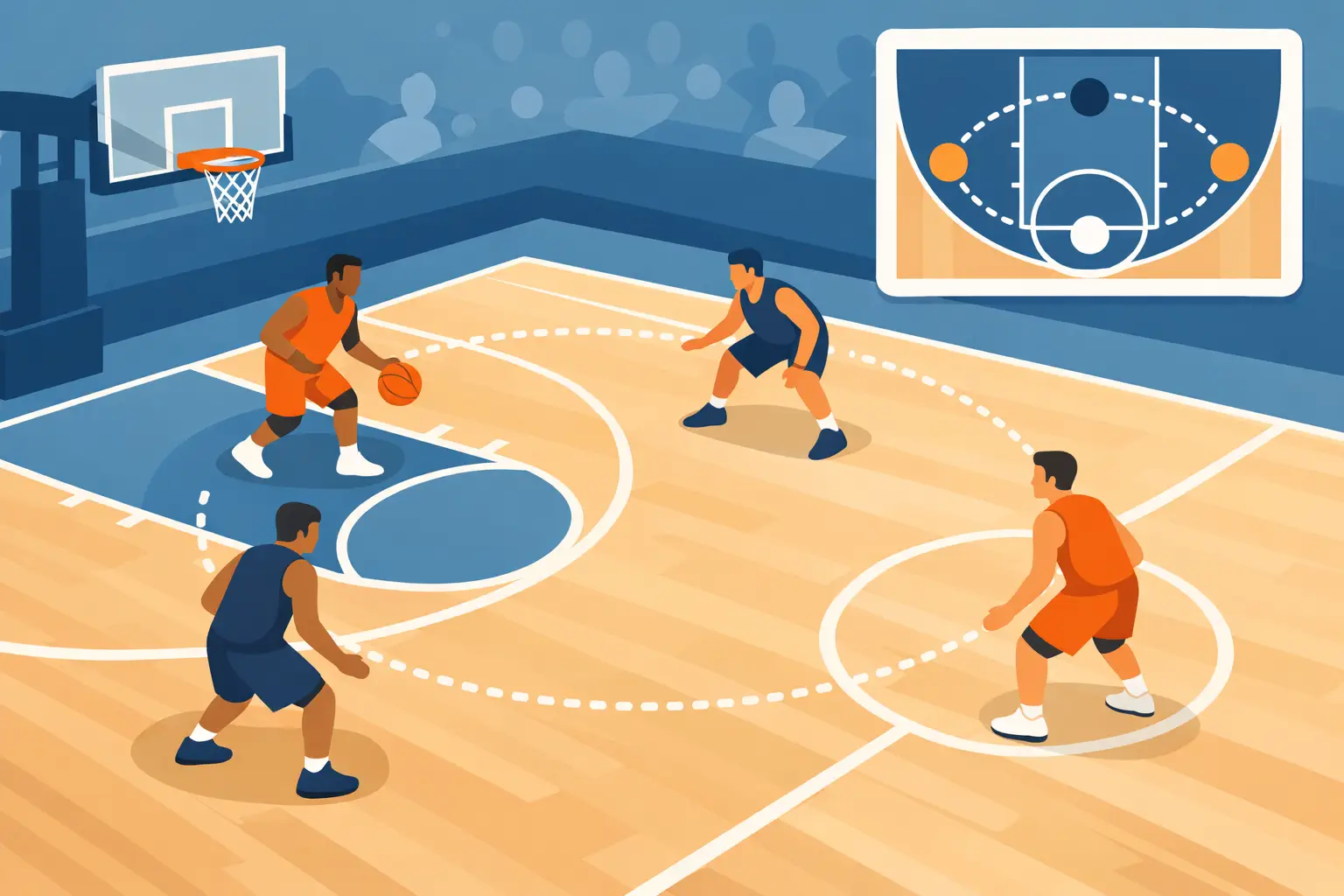
A lot of young players think spacing means, “stand farther apart.” That is part of it, but it misses the real point. If you want to learn how to understand basketball spacing, you have to stop seeing it as spots on the floor and start seeing it as a relationship between defenders, driving lanes, passing angles, and timing.
That shift matters because spacing is not just an offensive system term coaches yell from the sideline. It affects whether a drive is open, whether a shooter gets a clean catch, whether a cutter has room, and whether a help defender can guard two players at once. Players with strong basketball IQ do not just know where to stand. They know why their position helps the next read.
What basketball spacing actually means
Spacing is how the five offensive players position themselves to create usable room. Not empty room. Useful room. The goal is to make the defense cover more space than it wants to cover.
Good spacing stretches help defenders, opens passing windows, and creates cleaner decisions for the ball handler. Bad spacing shrinks the court. When two offensive players stand too close together, one defender can bother both. When a cutter runs into a driver, the offense helps the defense. When a corner player drifts too high, the low help defender has less ground to cover.
This is why spacing is tied directly to decision-making. Every movement changes the next read. A good offensive player understands that his spot is not random. It either improves the possession or clogs it.
How to understand basketball spacing in real games
The easiest way to understand spacing is to stop watching only the ball. Watch the defenders who are not guarding the ball. They will tell you whether the floor is spaced well.
If a help defender is standing in the lane and still close enough to contest a shooter, the spacing is probably poor. If that same defender has to choose between tagging the roller and closing out to the corner, the spacing is doing its job.
That is the key question: is the defense being forced to make a real choice?
When spacing is strong, defenders get stretched into longer recoveries. They arrive late. They stunt instead of fully helping. They point and talk more because they are under pressure. When spacing is weak, the defense looks comfortable. It loads up early, sits in gaps, and shrinks the court without giving up much.
For players, this means you should judge spacing by the pressure it puts on help defense, not by whether everyone looks spread out on a whiteboard.
The three spacing ideas every player should know
First, understand driving lanes. If the ball handler attacks and brings his defender with him, there must be open space to get downhill. If a teammate is standing one pass away but too close to the lane, that defender can help without really leaving the shooter. That is bad spacing even if the player is technically in the correct area.
Second, understand passing angles. Spacing is not only horizontal. It also affects how easy it is to pass out of pressure. A teammate can be “open” but still be in a poor passing window if a defender is sitting in the line of the pass. Better spacing improves both distance and angle.
Third, understand help responsibility. Offenses want to put one defender in conflict. Maybe he has to protect the rim and recover to the corner. Maybe he has to tag a cutter and still close out to the wing. If your positioning does not stress a help defender, it is probably not creating value.
Common spacing mistakes youth players make
The most common mistake is ball-watching. A player sees a teammate drive and instinctively drifts toward the ball. That usually brings an extra defender into the action and kills the lane.
Another mistake is cutting without purpose. Cuts are valuable, but only when they are timed and read correctly. Random cutting can bring two offensive players into the same space and make the defense’s job easier.
A third mistake is floating in no-man’s-land. Players often stand halfway between the corner and the wing, or halfway between the dunker spot and short corner, without understanding what that does to help defenders. Usually it shortens the closeout and reduces the offense’s advantage.
Parents can see this too. If possessions keep ending with crowded drives, tipped passes, or two teammates in the same area, the issue may not be skill. It may be spacing discipline.
What good spacing looks like by position
Guards usually need to recognize when they are creating space versus consuming it. If you are one pass away from the ball, your positioning should give the driver room while still keeping you available for a catch-and-shoot or quick attack. Sometimes that means lifting higher. Sometimes it means staying deep enough to stretch your defender. It depends on where the help is coming from.
Wings need to understand corners and slots. The corner is valuable because it forces a long closeout and makes low help harder. But the corner only works if the player stays disciplined and ready. Drifting up too early removes that pressure.
Bigs need to know that spacing is not just standing outside the paint. A big can improve spacing as a screener, roller, dunker spot player, or short-roll decision-maker. If the big stays in the lane too long, he crowds the drive. If he rolls with timing and occupies the rim protector, he creates space for everyone else.
So spacing is role-specific, but the principle is the same. Your location should increase pressure on defenders and improve the next decision.
How to use film to understand basketball spacing faster
Film study is the fastest shortcut because spacing happens quickly in live play. Most players only see the mistake after the possession is already over. Film lets you freeze the moment before the pass, drive, or help rotation.
When you watch film, pause on three moments: the catch, the first dribble, and the help rotation. On the catch, ask if the floor is balanced. On the first dribble, ask who is being put in conflict. On the help rotation, ask whether the spacing created a real advantage or let the defense recover easily.
Do not only watch made shots. Some made shots come from poor process. A tough pull-up over two defenders might go in, but that does not mean the spacing was good. You want to study whether the offense created a clean read.
This is where structured breakdowns help young players most. Instead of hearing “space out” over and over, they start seeing the pattern. That is a huge part of how C-Buckets Hoops IQ Lab teaches players to transfer concepts from film directly into games.
A simple way to read spacing during a possession
Try this in your next game or film session. As the action starts, identify the nearest help defender. Then ask, “What is making his job hard right now?”
If you cannot answer that, the offense may not be spaced well.
Maybe the corner shooter is pinning him low. Maybe the roller is forcing him to tag. Maybe the slot player is staying wide enough to punish a stunt. Good spacing creates a chain reaction where every helper has a consequence for leaving his man.
Then ask the second question: “If the ball moves right now, who has the longest recovery?” That usually tells you where the spacing advantage is.
This is a much smarter approach than memorizing spots without context. Spots matter, but only because they shape defensive decisions.
Why spacing changes from team to team
There is no single perfect spacing map. It depends on personnel, offensive system, and level of play.
A team with strong shooters can stay wider and punish help more easily. A team with a dominant post player may use spacing to feed the block and punish doubles. A youth team with inconsistent shooting may need cleaner cutting and simpler drive-and-kick spacing rather than copying NBA alignments that do not fit its strengths.
That is an important lesson for players and parents. Do not confuse advanced-looking offense with effective offense. Good spacing is about fit. It should match what your team can actually execute under pressure.
Train spacing like a basketball IQ skill
You do not improve spacing just by hearing it in practice. You improve it by building better habits of recognition.
Start by learning where help defenders want to stand. Then study how your position changes their choice. In workouts, do not only practice the move. Practice the read after the move. If a coach drives baseline, where should you drift? If the big rolls and two defenders collapse, where is the outlet? If you cut and the lane is occupied, should you clear through or stop short?
These are spacing questions, but they are really decision-making questions. The smartest players make the floor feel bigger because they understand timing, distance, and defensive pressure.
If you are a parent, this is also a useful lens for watching games. Instead of asking only whether your child scored, watch whether they created room, held the corner, lifted at the right time, or avoided crowding a drive. Those habits often lead to better offense before the box score catches up.
The next time you watch a possession, do not ask, “Where are they standing?” Ask, “Who is being stressed by their spacing?” That question will teach you the game a lot faster.
Leave a Reply