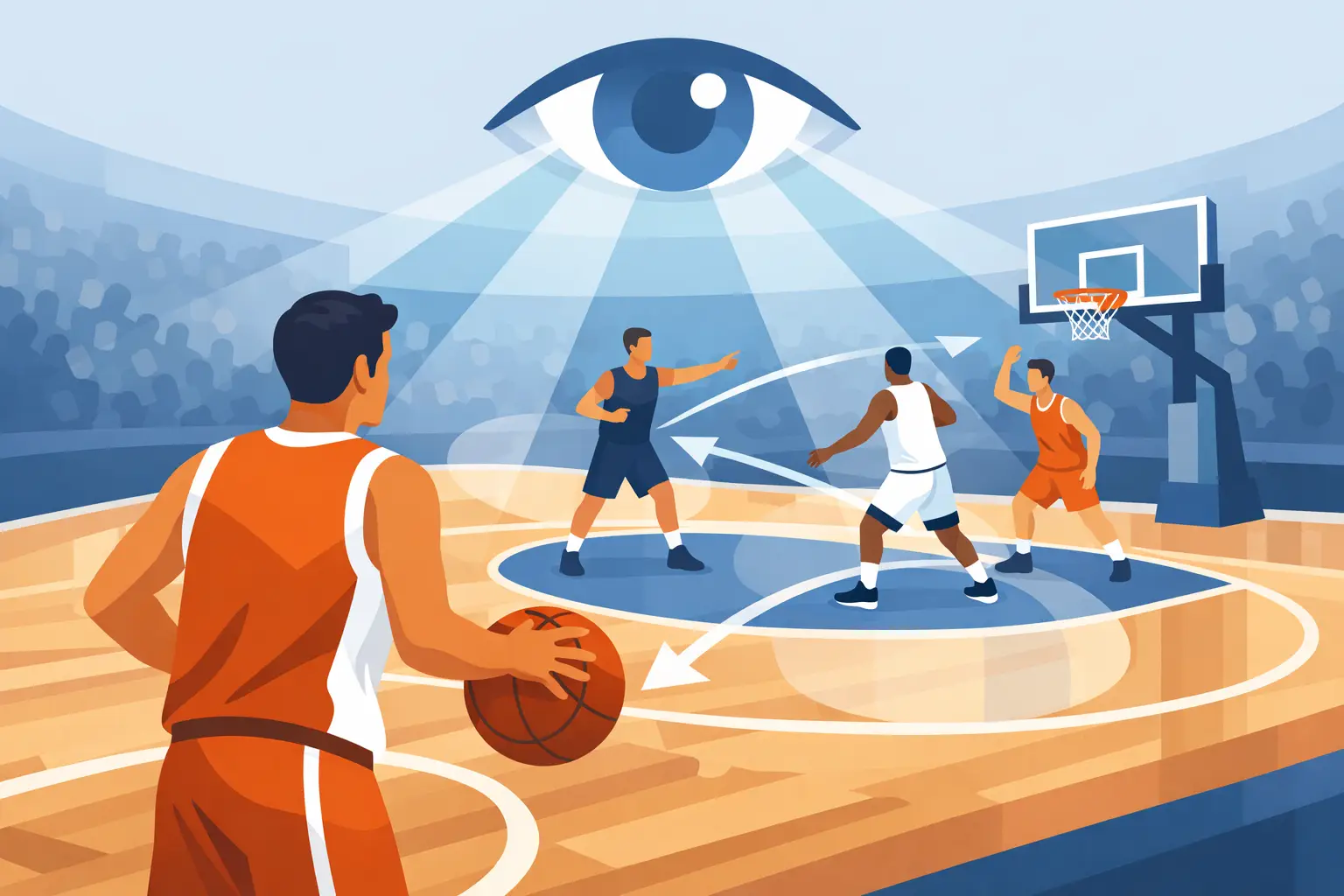
A lot of players think court vision is something you either have or you do not. That is usually just a sign they have never been taught how to improve court vision basketball players actually use in real games. Great passers are not guessing. They are recognizing patterns early, reading help defenders, and understanding where the next play is coming from before the ball even gets there.
That matters because court vision is not only about flashy passes. It is about decision-making. It shows up when a guard sees the low man rotate and throws the kick-out on time. It shows up when a wing catches, reads a hard closeout, and hits the cutter without holding the ball. It shows up when a player keeps spacing clean because they understand what their teammate is trying to create.
If you are a middle or high school player, this is good news. Court vision can be trained. If you are a parent, this is also helpful to know because smarter basketball is not random development. It comes from learning what to look at, when to look at it, and how to connect film study to live-game action.
What court vision really means in basketball
When people say a player has great vision, they usually mean more than passing accuracy. Court vision is the ability to see the full floor, identify the most important defender, and make the right read on time. Timing matters just as much as sight. A pass that is technically open for half a second can still be a bad decision if you see it late.
That is why some players look open but never get the ball. The passer is staring at the first defender instead of reading the whole action. On the other side, some players force difficult passes because they notice the target but miss the help defense sliding into the lane.
Good vision is built on three things – awareness, recognition, and decision speed. Awareness is seeing teammates, defenders, and space. Recognition is understanding what those movements mean. Decision speed is choosing quickly enough for the read to matter.
How to improve court vision basketball players can trust in games
The first step is changing what you focus on. Many young players watch the ball too much, including when they have it. That narrows everything. Instead of reading the entire defense, they lock onto one teammate or one driving lane and miss the second and third options.
The best players widen their attention. They know where the strong-side help is. They feel where the tag defender is coming from. They notice if the weak-side corner is occupied or empty. None of that requires magic. It requires training your eyes to scan the floor with purpose.
A simple way to start is to ask one question before every catch: what is the defense taking away, and what is it leaving open? That keeps you from playing on autopilot. It also pushes you to read defenders, not just memorize a play.
Start with your eyes before your dribble
One common mistake is dribbling first and reading second. That usually leads to late passes and crowded drives. If you catch the ball and immediately lower your eyes, you lose valuable information.
Try to see the floor on the catch. Peek at the rim, your defender, and the next line of help. If you are bringing the ball up, get your eyes ahead before crossing half court. You should already know your spacing and where the next advantage might come from.
This is especially important for guards, but wings and bigs need it too. Court vision is not a point guard-only skill anymore. Any player who can keep the ball moving and make the next read becomes more valuable.
Learn to read the help defender
Most good decisions in basketball come from reading one key defender. Sometimes that is the low man on a drive. Sometimes it is the weak-side wing tagging the roller. Sometimes it is the on-ball defender going under a screen.
Young players often try to see all five defenders at once. That sounds smart, but in real time it can slow you down. Start by identifying the defender who controls the next pass. If that defender commits to stop the ball, somebody else is open.
For example, on a drive from the wing, if the low man steps up to help at the rim, the drop-off or corner pass may be there. If the low man stays home, the layup may be available. That is court vision in action – not seeing everything perfectly, but seeing the right thing early.
Spacing affects vision more than players realize
A lot of bad reads are really spacing problems. If your team is too close together, passing windows shrink. Driving lanes disappear. Help defenders can guard two players at once. Then players blame their vision when the real issue was floor balance.
Understanding spacing helps you anticipate where teammates should be before you even look. That speeds up your reads. If the corner is filled properly and the dunker spot is occupied correctly, your eyes know where to go when help rotates.
This is one reason film study matters so much. When players watch possessions with guidance, they start noticing why one read was clean and another looked crowded. They see that court vision is connected to team concepts, not just individual creativity.
Film study sharpens pattern recognition
If you want a serious answer to how to improve court vision basketball development should include film. Live reps matter, but film slows the game down enough for players to actually learn the patterns.
On film, you can pause before the pass and ask, what is the defense showing here? Who is the helper? Where is the open space? Then you can watch the clip play out and compare your read to the real result. That teaches recognition much faster than telling a player to just keep playing.
For middle and high school athletes, short film sessions are usually better than long ones. You do not need an hour of advanced terminology. You need a focused lesson on one game situation – maybe baseline drives, maybe pick-and-roll weak-side tags, maybe post-entry reactions. When the lesson is clear, the transfer to practice is stronger.
Practice habits that build better court vision
The best court vision drills are not always the flashiest ones. They are the ones that force players to gather information early and make decisions under control.
Small-sided games are excellent for this because they create frequent reads. In 3-on-3 or 4-on-4, there is more space, more touches, and more chances to recognize help defense. Players cannot hide in those settings. Every catch means a decision.
Advantage drills also help. If an offense starts with a numbers edge or a defender out of position, the ball-handler has to identify the best option quickly. That is closer to real game basketball than dribbling through cones with your head up.
You can also add simple vision rules in workouts. Make players call out the location of a coach or teammate while dribbling. Require a paint touch before a kick-out read. Use one-more passing sequences where the first pass is good but the second pass is best. Those details train players to look beyond the obvious play.
Play with pace, not speed
This is where young players get mixed up. They think improving vision means playing faster. Sometimes it does. Sometimes it means slowing down just enough to stay balanced.
If you are out of control, your eyes rush and your reads get worse. Playing with pace means attacking with purpose, coming to controlled jump stops, and keeping options alive. A player who can get into the lane under control usually sees more than a player who drives at full speed with one plan.
That is a trade-off worth understanding. More aggression is good if you can still read the floor. If your speed removes your ability to process help defenders, it is not helping your game.
What parents should watch for
Parents do not need to become coaches to support this area of development. But it helps to know what progress looks like. Court vision is improving when a player makes earlier reads, forces fewer difficult passes, and understands where teammates should be in common actions.
It also shows up in lower-turnover possessions that never make highlight reels. Maybe your child swings the ball on time instead of dribbling into pressure. Maybe they hit the cutter one beat earlier. Maybe they stop driving into crowded gaps because they recognize the help sooner.
Those are real signs of growth. They may not look as exciting as a no-look pass, but coaches value them because they help teams function.
The fastest way to improve
If you want to improve court vision, stop treating it like a mystery skill. Study common game situations. Learn which defender matters most in each action. Practice seeing the floor before the dribble. Then review your own possessions and ask whether you missed a read, misread spacing, or made the right read too late.
That is the type of work that turns basketball IQ into visible production. It is also why programs like C-Buckets Hoops IQ Lab focus so heavily on guided film study instead of only skill drills. Players do not just need more reps. They need better eyes.
The player who sees the game one step earlier does not always look flashy. They just make the game easier for everybody around them. That is the kind of court vision worth building.
Leave a Reply