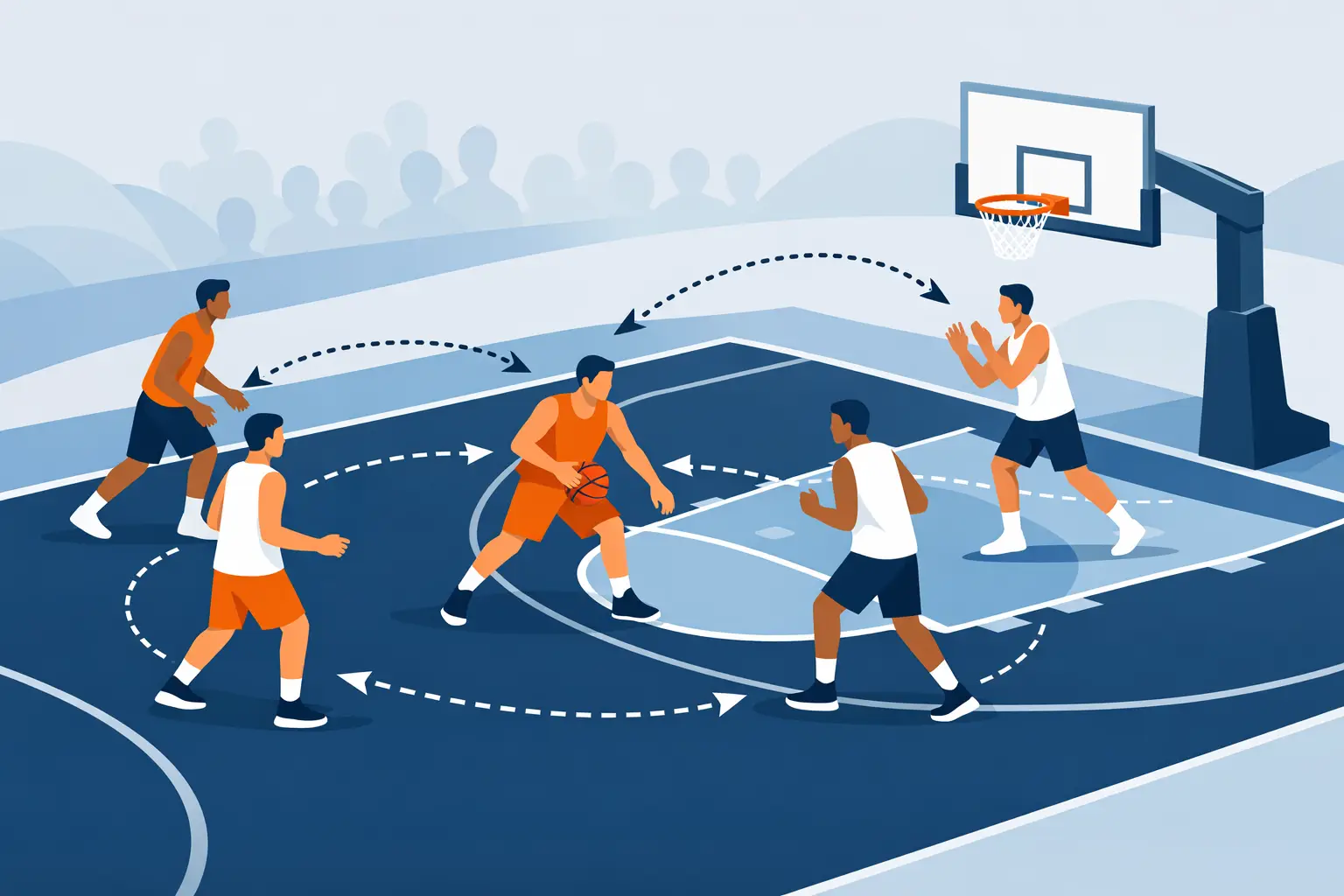
The possession usually breaks down before the shot. A player drives into traffic, two teammates drift toward the ball, and suddenly the defense is guarding three people with one help defender. That is why basketball spacing for beginners matters so much. Good spacing is not advanced theory. It is one of the fastest ways for young players to make better reads, get cleaner shots, and stop making the game harder than it needs to be.
A lot of players think spacing just means standing far apart. That is only part of it. Real spacing is about creating useful distance between offensive players so the defense has to make longer, tougher decisions. When your team is spaced well, driving lanes open, passing angles get cleaner, and help defense has farther to travel. When your team is spaced poorly, even good ball-handling and solid effort can look ineffective.
What basketball spacing for beginners actually means
At a basic level, spacing means occupying the floor in a way that keeps defenders stretched. You want enough room between teammates that one defender cannot easily bother two players at once. For most beginner teams, that means avoiding bunching up near the ball, avoiding standing shoulder-to-shoulder on the perimeter, and keeping the paint from getting crowded unless someone is cutting through it.
Think of the court as shared space with a purpose. If one player has the ball on the wing, the other four players should not all drift toward that side to watch. Someone should stay opposite. Someone should fill the corner. Someone might be high as a safety valve. If a cutter goes through the lane, they should clear out instead of stopping in the middle and bringing an extra defender with them.
This is where players often get confused. Spacing is not frozen positioning. It is organized movement. You are not trying to stand still in perfect spots for an entire possession. You are trying to maintain balance while the ball, the defense, and your teammates move.
Why spacing changes everything for young players
For middle school and high school athletes, spacing often decides whether a possession feels simple or chaotic. Younger teams usually struggle less because of a lack of effort and more because they crowd each other without realizing it. A smart defender loves that. They can stunt at the ball, recover to a shooter, and clog the lane with very little risk.
Good spacing gives the ball-handler clearer reads. If help comes from the corner, the kick-out is obvious. If the defender stays home, the drive is cleaner. If two defenders jump the ball, the next pass is easier to see because teammates are not stacked in the same area.
It also helps players without the ball. Many young athletes think offense is mostly about what the dribbler does. Not true. A wing who holds proper corner spacing or lifts at the right time can create an open lane without touching the ball. That is winning basketball IQ, and coaches notice it.
The five-out idea is the easiest place to start
For teaching beginners, five-out spacing is one of the clearest models because it spreads the floor and gives every player a simple reference point. Picture five perimeter spots: top, two wings, and two corners. You do not need to run a complicated offense to learn from this shape.
If the ball is at the top, the wings and corners should stay wide enough to stretch the defense. If the ball moves to the wing, the corner stays deep, the top player becomes a reversal option, and the opposite side stays spaced as weak-side support. If someone drives baseline, teammates should avoid drifting into the same lane line area.
That does not mean five-out is always better than playing with a post. Some teams have a strong interior player, and they should use that. But for beginners, five-out makes spacing mistakes easier to spot. If three players end up on one side and nobody fills behind the drive, the problem becomes visible right away.
Three spacing mistakes beginners make all the time
The first is ball watching. The pass goes to one side, and everyone takes two or three steps toward it. Players do this because they want to feel involved, but they actually shrink the court. If you are one pass away, your spacing matters. If you are two passes away, it matters even more because you stretch help defenders.
The second is clogging the paint after cutting. A good cut creates pressure. A bad finish to the cut kills spacing. If you cut through and do not get the ball, clear to the opposite side or fill an open spot. Do not stop under the rim unless your role in the action puts you there.
The third is standing in a teammate’s driving lane. This happens a lot with slot and wing players. A teammate starts attacking middle, and another offensive player stays parked one step away from the lane line with their defender sitting in help position. The offense thinks the defense made a great play. Usually, the spacing created the problem first.
Simple rules players can use right away
Young players do not need a thick playbook to improve spacing. They need a few habits they can recognize in film and repeat in games.
Stay wide when you are away from the ball. If you are in the corner, stay low and deep enough to make your defender choose between helping at the rim and protecting the shooter. If you are on the weak side, do not drift toward the top just because the ball is there.
Move with purpose after every pass or drive. When the ball is driven at you, you may need to drift, lift, or slide to create a passing window. When the lane is occupied, do not cut into the same space unless the action calls for it.
Clear through the paint. The lane is a highway, not a parking lot. Cut hard, make the defense react, and then get out if the pass is not there.
See both ball and space. Good offensive players are not just watching the defender in front of them. They are reading where the next open space will appear.
How to tell if your spacing is good during a game
Most beginners judge a possession by whether the shot goes in. That is too late. A better question is whether the floor looked open enough for the offense to force a real defensive decision.
If the ball-handler has room to attack and can clearly see the help defender, spacing is probably decent. If one pass creates a catch-and-shoot chance, spacing is doing its job. If every drive runs into two extra defenders and every kick-out pass feels crowded, the spacing is probably off.
Parents can watch this too. You do not need to know every set. Just notice whether offensive players are spread across useful areas of the floor or whether they keep drifting into each other’s space. Once you start seeing that pattern, the game makes a lot more sense.
Film study is where spacing starts to click
Spacing is one of the best concepts to learn through film because players can finally see what they felt during the game. A rushed drive often looks different when you rewind it. Maybe the driver was fine, but a teammate collapsed from the corner. Maybe the pass was available, but the weak-side player never lifted into view.
This is why structured film work matters. Players improve faster when they can connect a mistake to a visual pattern instead of hearing a coach repeat, “Space out.” At C-Buckets Hoops IQ Lab, that is a major part of the teaching process – turning broad coaching phrases into specific game reads players can actually recognize.
For a beginner, even ten minutes of focused film on spacing can change how they move off the ball in the next practice. That is real development. It is not random hustle. It is seeing the floor better.
Basketball spacing for beginners is really about helping your teammates
One of the best ways to understand spacing is to stop thinking about your own spot and start thinking about what your position does for the player with the ball. Are you giving them a passing angle? Are you pulling a help defender farther away? Are you staying out of the lane so they can finish or force help?
That team-first mindset is where smarter offense begins. Great spacing does not always show up in the box score, but it shows up in quality possessions. Coaches trust players who create clean reads for others. Teammates love playing with them too.
The next time you watch a game, do not follow only the ball. Watch the player in the weak-side corner. Watch the cutter leave the paint. Watch how one smart repositioning move can open the entire floor. That is where the game starts to slow down, and that is when a beginner starts becoming a real basketball player.
Leave a Reply