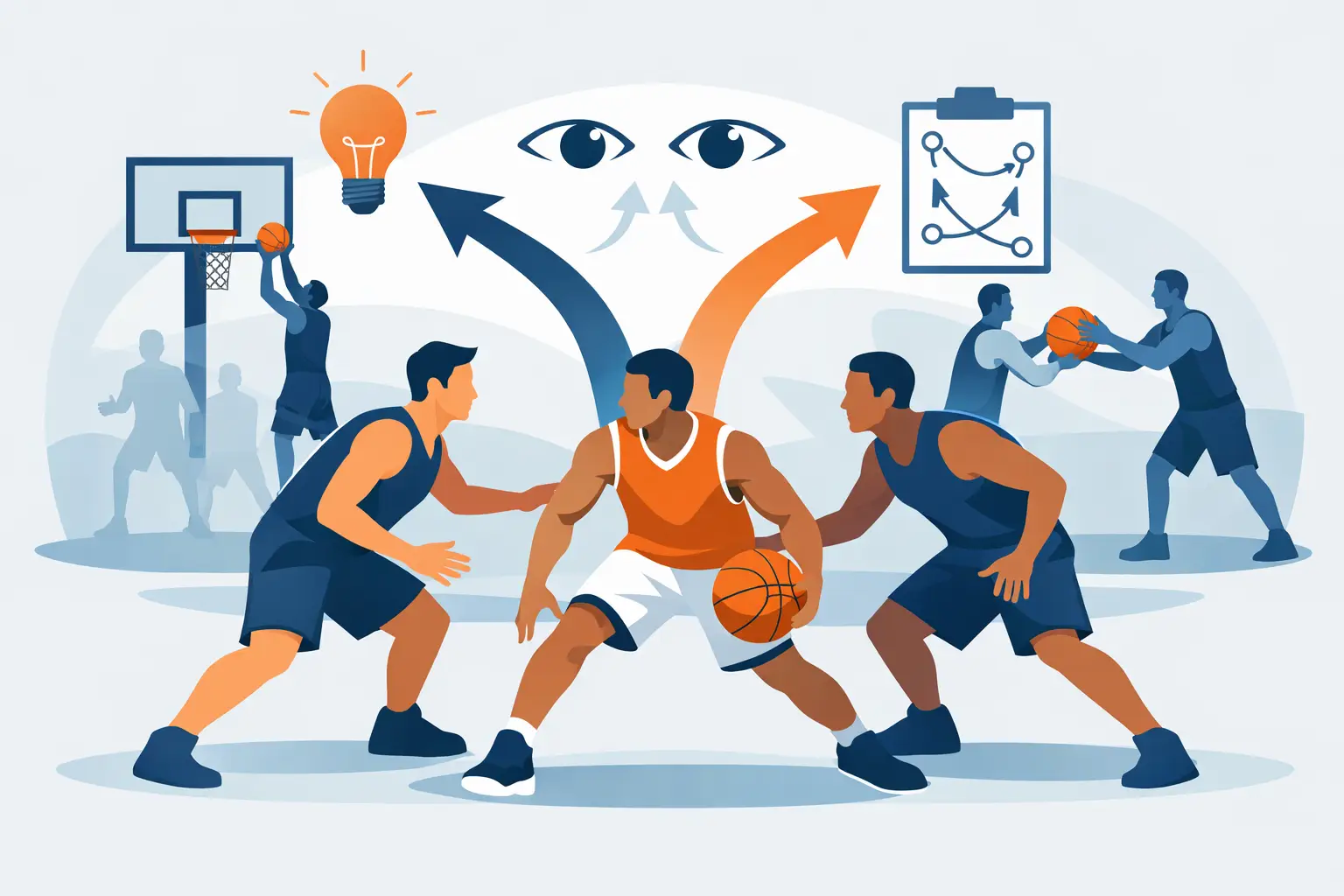
Most young players do not struggle because they lack effort. They struggle because the game moves faster than their eyes and mind can process. That is why basketball decision making drills matter. If a player cannot recognize help defense, see the low man, or understand when spacing is broken, better handles and extra shooting reps will only take them so far.
The goal is not to make practice feel complicated. The goal is to train players to see patterns earlier and make the next right play faster. For middle and high school athletes, that usually means building drills around real reads – not empty moves with no defender, no consequence, and no decision.
What basketball decision making drills should actually train?
A good drill teaches more than technique. It teaches recognition. Players need to identify where the help is coming from, whether the defender is top side or trailing, when to attack a closeout, and when to move the ball before the defense gets set.
That is the difference between a skill workout and a game transfer workout. A skill workout can improve footwork or ball control. That still has value. But if the player cannot connect the skill to a read, the improvement often disappears under pressure.
For younger athletes, decision-making training should usually focus on three things first: advantage recognition, spacing awareness, and simple read progression. In plain terms, can the player tell when they have an edge, can they keep the floor balanced, and do they know their first and second options if the defense takes away the first one?
1. Advantage or no advantage drive drill
Start with a ball handler on the wing, a live defender, and a coach or teammate acting as help near the nail or block. The offensive player attacks only if the defender is off balance or the help is late. If there is no advantage, the player must pull it out, pass, or re-space.
This sounds basic, but it teaches one of the most important habits in basketball: not every catch is a green light to force action. A lot of turnovers at the youth level come from players attacking into a loaded lane because they decided before reading.
The coaching point is simple. Ask, “Did you create an advantage or did you drive into traffic?” That question helps players stop confusing aggression with good offense.
2. 2-on-1 to 2-on-2 progression
This drill begins with a clear read and then adds complexity. In 2-on-1, the ball handler and teammate attack one defender in transition or from a side action. The offensive player must force the defender to commit before making the pass or finishing.
Once players handle that well, turn it into 2-on-2 by adding a recovering defender. Now the first read is not enough. The ball handler has to read the primary defender and the recovery angle. The teammate has to time the cut or drift instead of standing still.
This is a strong teaching tool because it trains patience. Young players often make the first available pass instead of the best pass. In real games, that extra half-second matters.
3. Small-sided basketball decision making drills
If you want more reads in less time, go smaller. Three-on-three and four-on-four create far more decision reps per player than full five-on-five. There is less hiding, more space responsibility, and more frequent touches.
You can shape these games around one concept at a time. Maybe the rule is that every paint touch must lead to a finish, kick-out, or drop-off in two seconds. Maybe the offense gets an extra point for a skip pass against a helping defense. Maybe the defense is told to tag aggressively so the offense has to recognize the open shooter.
The value is not just competition. The value is constraint. Good constraints force the player to read a specific problem repeatedly until the solution becomes more natural.
4. Closeout read drill
Put a passer at the top, a shooter on the wing, and a defender closing out from help position. On the catch, the offensive player has three options: shoot if open, attack the top foot if the defender flies out, or make the extra pass if a second helper steps in.
This drill works because it mirrors a common game moment. A player catches, the defense is rotating, and the decision has to happen quickly. Many youth players treat every closeout the same. They either always shoot or always drive. Good players read the defender’s body position first.
Make sure the closeout is realistic. If the defender is jogging with no intent, the read is fake and the drill loses value.
5. Pick-and-roll pocket read drill
For guards, this is one of the most useful basketball decision making drills because it teaches read order. Use a ball handler, screener, on-ball defender, and help defender. The ball handler comes off the screen and must identify whether the defense is in drop, switch, hard hedge, or late recovery.
For younger players, keep the progression simple. First read the rim. Second read the roller. Third read the weak-side help and corner. That structure prevents the common mistake of staring at one option and missing the bigger picture.
Not every middle school team runs heavy ball screen action, so this drill depends on the player’s level and role. But even if the action itself is limited, the habit of reading multiple defenders in sequence still carries over.
6. Drive, stop, pivot, and scan
A lot of youth players can beat the first defender but fall apart when the help collapses. They pick up the ball too early, jump without a plan, or throw blind passes. This drill fixes that by teaching controlled stops and second reads.
The player drives into the lane, meets a helper, jump stops or stride stops under control, then pivots and scans for the corner, dunker spot, or outlet. Add live defenders once the footwork is solid.
This is not the flashiest drill, but it develops composure. When players learn they do not have to rush every paint touch, their passing improves and their turnovers usually drop.
7. Relocation and one-more pass drill
Decision-making is not only for the player with the ball. Off-ball players also make winning decisions. After a drive and kick, can the shooter recognize when to shoot, when to attack the next closeout, and when to make the one-more pass to a better shot?
Set up a simple chain on one side of the floor. The ball gets driven, kicked out, swung, and then the next player must read the rotating defense. This teaches spacing and timing at the same time. If players stand too close or move too late, the read disappears.
Parents watching games often notice the turnover but miss the spacing mistake that caused it. This kind of drill helps everyone understand that decision-making starts before the catch.
8. Guided film plus on-court rep pairing
Some reads improve faster when players see them before they try them. Show a short film clip of a drive against a gap help defender, a corner tag on a roller, or a poor spacing possession where two teammates kill the lane. Then run the same situation on the floor.
This matters because some players are not making bad decisions from selfishness or laziness. They genuinely do not recognize the pattern in real time yet. Film gives them a picture. The drill gives them the repetition.
That pairing is a major reason structured teaching works so well for developing athletes. They are not just told what was wrong. They can see it, name it, and then practice the correction.
9. Shot clock decision games
Sometimes a player can make good reads in calm drills but still rush in games. Add a short clock to force faster processing. Play three-on-three or four-on-four with eight to ten seconds on each possession. Now the offense has to organize quickly, create an advantage, and make a clean decision under time pressure.
This is where weak habits show up. Players who hold the ball too long get exposed. Players who understand spacing and quick reads become much more effective.
The trade-off is that shorter clocks can create sloppy habits if used too often. If the player is still learning the basic read, constant speed pressure can hurt more than help. First build the picture, then add urgency.
How to know if the drills are working
Do not judge these drills only by whether the player scores. Judge them by whether the read matched the defense. A missed layup after the right read is still progress. A made floater over three defenders after ignoring an open teammate is not the kind of habit you want to reward.
Look for cleaner spacing, earlier passes, better closeout attacks, and fewer dead-end drives. Those are real signs of better basketball IQ. Over time, players start playing with less panic. The game slows down because their recognition speeds up.
At C-Buckets Hoops IQ Lab, that is the core idea behind development that actually transfers. Train the eyes, train the understanding, and the skill has a much better chance to show up when the game gets crowded.
If you want a smarter player, do not just ask for harder workouts. Ask for better reads, repeated the right way, until good decisions become part of how they play.
Leave a Reply