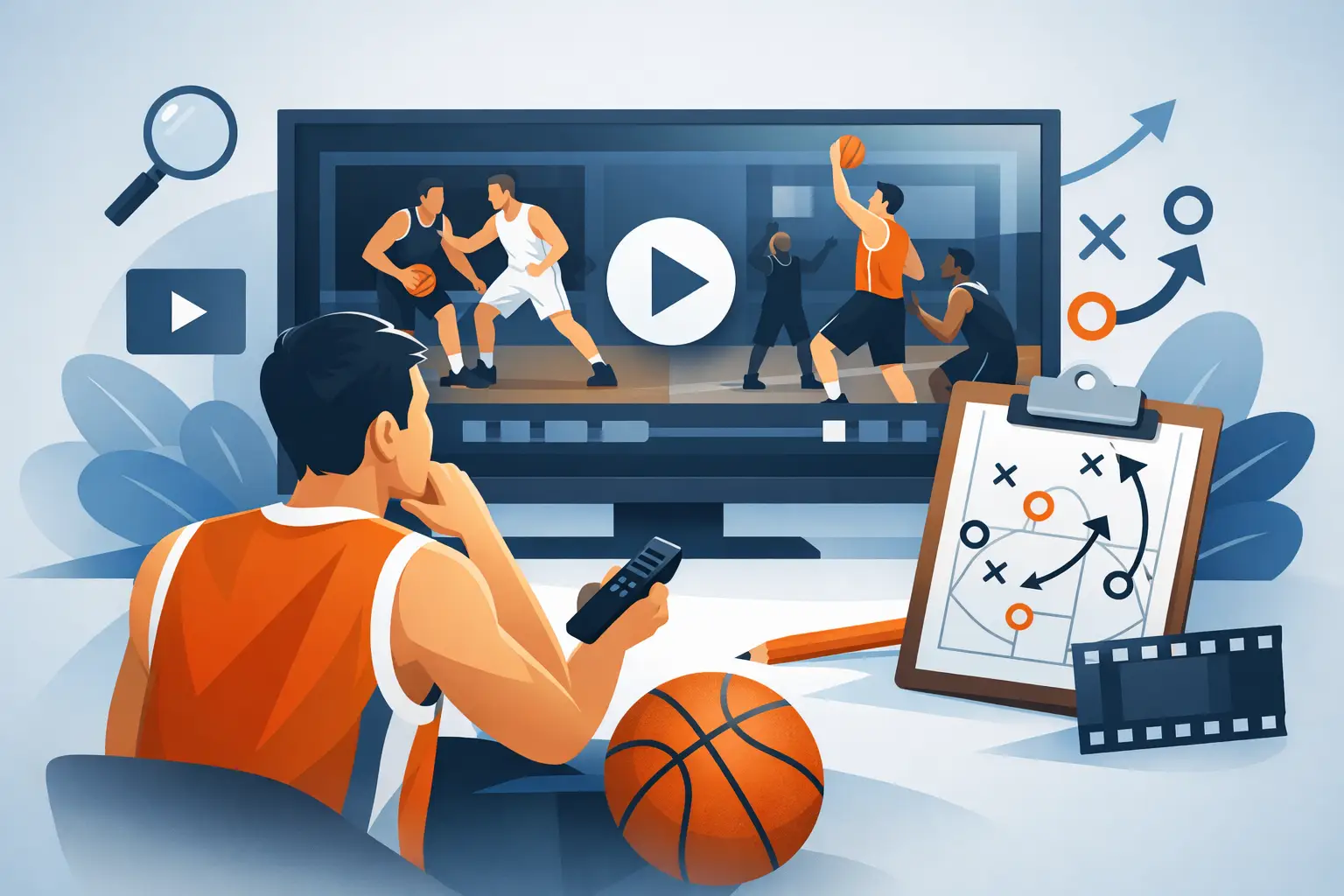
A guard comes off a ball screen, sees two defenders jump to the ball, and still forces a tough pull-up. Next possession, the same coverage shows up, but this time the skip pass is open for a corner three. That difference is not about effort. It is about recognition. Basketball film study for players helps you see those patterns before the next game asks you to solve them in real time.
Most young players think film is for college teams, NBA staffs, or varsity starters. It is not. If you are in middle school or high school, film can speed up your development because it teaches you what to look for before the ball is in your hands. That matters because games move too fast for guessing. Better players are often better readers.
Why basketball film study for players matters
Skill work still matters. You need to handle, shoot, pass, defend, and move. But two players can have similar skill levels and get very different results because one sees the game earlier. Film study trains that part.
When players watch the right clips with the right questions, they start noticing spacing, help defense, timing, and advantage situations. They stop treating every possession like a random event. They begin to understand why a drive worked, why a cut was late, or why a defender got beat even before the shot went up.
That is the real value. Film does not just show mistakes. It builds pattern recognition. Once a player recognizes the same actions over and over, decision-making gets quicker and calmer. That is how basketball IQ becomes visible on the court.
For parents, this matters too. A lot of frustration comes from seeing something go wrong without knowing why. Film gives the game language. Instead of saying, “You have to play harder,” you can talk about better spacing, stronger weak-side positioning, or making the simple pass on time.
What players should actually watch on film
A common mistake is watching highlights and calling it film study. Highlights can be fun, but they usually show the finish, not the read that created it. Real study starts earlier in the possession.
Watch what happens before the shot. Where is the spacing? How is the defense loaded? Is the weak-side defender tagging the roller? Does the on-ball defender get screened clean or slide under? These details explain the decision.
For younger players, it helps to focus on a small number of categories instead of trying to study everything at once. Start with your role. If you are a point guard, pay close attention to ball screens, early help, transition reads, and when to attack versus when to move it. If you are a wing, study drive-and-kick spacing, closeout reads, cutting windows, and how to relocate after a pass. If you are a post, focus on seals, duck-ins, help-side positioning, short-roll decisions, and defensive rotations.
It also helps to watch yourself, not just elite players. Watching high-level players can show the standard, but your own film reveals your habits. Maybe you catch the ball and hold it too long. Maybe you drift into a teammate’s driving lane. Maybe you help one step too far and give up a corner three. Those patterns are easier to fix when you can see them clearly.
How to study film without wasting time
The best film sessions are short and specific. Most young players do not need an hour of clips. They need 10 to 20 focused minutes with one teaching point.
Start by choosing one theme for the session. It might be pick-and-roll reads, transition defense, off-ball spacing, or closeouts. Then watch a small group of clips and pause often. Ask simple questions: What did I see? What was the defense taking away? What was the next open option? Did my spacing help the possession or hurt it?
That pause-and-predict method is where learning happens. Before the clip finishes, make a decision in your head. Then see if the player made the same one. This trains anticipation instead of passive watching.
Take notes, but keep them practical. You do not need a long report. Write one or two sentences you can carry into practice. Something like, “When the low man steps up to the drive, corner is open,” or “On defense, I am opening my stance too much and giving up middle drives.” Good notes lead to action.
Basketball film study for players should connect to live reps
Film only helps if it changes behavior on the court. That is where a lot of players miss the point. They watch clips, nod their head, and then go right back to old habits in practice.
The fix is simple. After every film session, attach the lesson to one game-speed rep. If you studied closeout reads, then in your next workout play from the catch and make a live decision in two dribbles or less. If you studied ball-screen coverage, then in practice call out what coverage you see before the action starts. If you studied help defense, then rep your rotations and recoveries with clear verbal cues.
This matters because basketball is not a classroom-only sport. You are training your eyes and your body together. Film gives you the picture. Reps give you the response. One without the other is incomplete.
There is also a trade-off here. Too much film without action can make players overthink. Too many drills without film can make players move hard without understanding why. The sweet spot is short study, clear teaching, and immediate application.
What young players often miss on film
Most youth players watch the ball. Smarter players learn to watch the defenders away from the ball.
That is where the clues are. The weak-side help defender tells you whether the drive is available. The nail defender tells you whether the gap is crowded. The corner defender tells you whether the skip pass is there. On defense, the player one pass away often tells you what rotation has to happen next.
Another missed detail is timing. Many decisions fail not because they are wrong, but because they are late. The pass was open for half a second, then the window closed. The cut was right, but the teammate had not created the driving angle yet. Film teaches timing because you can rewind and notice exactly when the advantage appeared.
Players also miss how their positioning affects teammates. Poor spacing does not always show up as your turnover. Sometimes it shows up as someone else having nowhere to drive. Film helps players understand that basketball is connected. Your location changes another player’s read.
A better way for parents to use film
Parents do not need to become assistant coaches. But they can become more helpful by learning what their athlete is trying to read.
The best approach is to keep conversations simple and specific. Instead of reacting to makes and misses, ask about decisions. “What was the defense showing there?” is a better question than “Why didn’t you shoot?” It invites learning instead of pressure.
It also helps to focus on one teaching point from a game instead of reviewing every possession in the car ride home. Young players retain more when feedback is narrow and calm. If the lesson is spacing, stay on spacing. If the lesson is transition defense, stay there.
That is one reason structured breakdowns matter. A guided system keeps players and parents from guessing about what matters most.
What progress looks like after consistent film study
The first change is usually not scoring. It is clarity. Players hesitate less. They know where the next pass is likely to be. They arrive earlier on defense. They make simpler plays.
Then the bigger gains show up. Turnovers drop. Shot quality improves. Coaches trust the player more because possessions become steadier. Teammates play better around them because spacing and timing improve.
This is especially true for players who are not the biggest, fastest, or most explosive athlete on the floor. Basketball understanding is a real separator. It helps skilled players maximize their tools, and it helps average athletes become winning players.
At C-Buckets Hoops IQ Lab, that is the whole point of guided film study. The goal is not to impress players with complicated language. The goal is to teach them how to read the game in a way they can actually use in school, club, and grassroots basketball.
If you want better results, start treating film like part of training, not extra credit. Watch fewer clips, ask better questions, and carry one lesson into your next run. The game starts slowing down when your eyes get trained first.
Leave a Reply