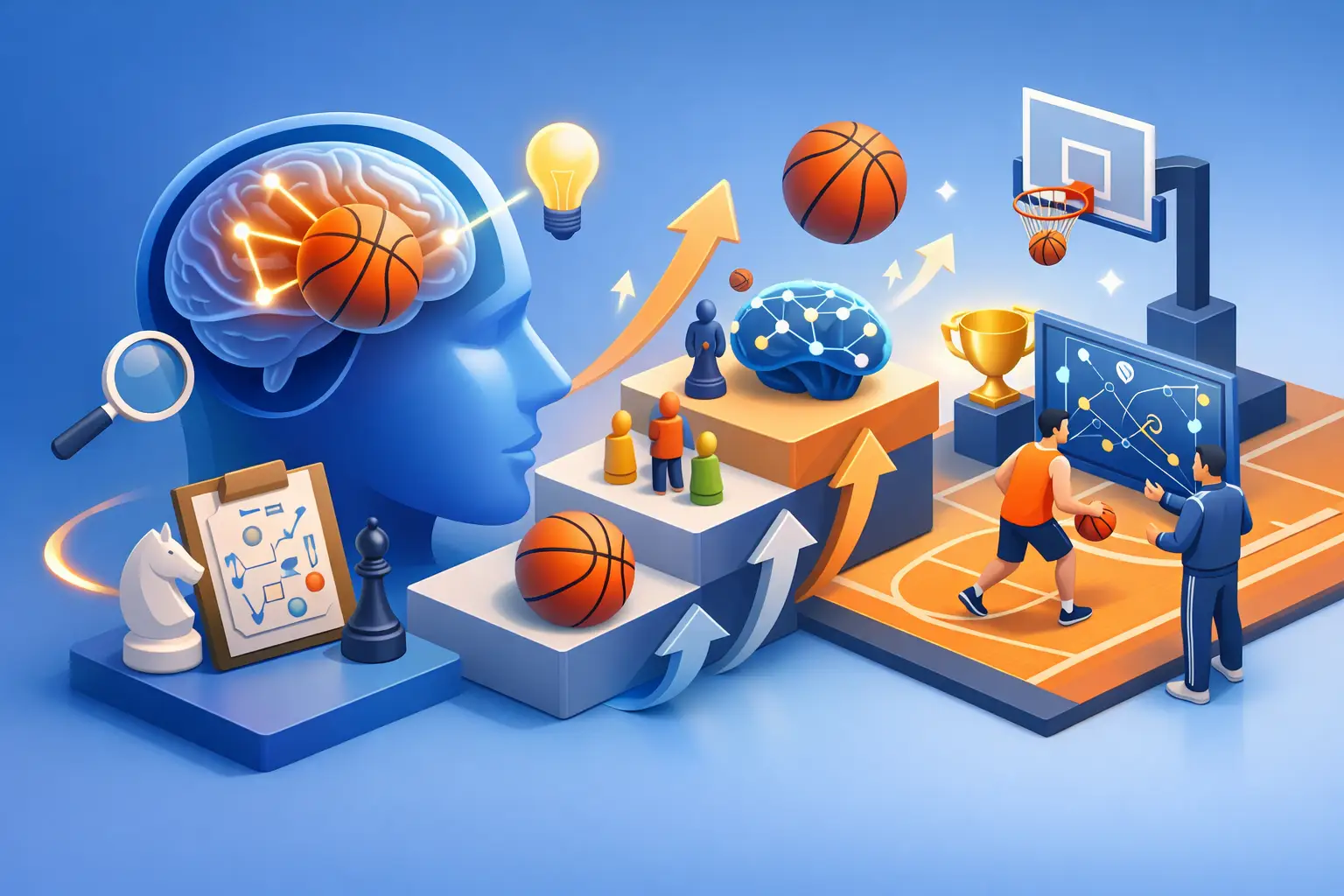
A player can have a solid handle, decent shot, and good effort – and still hurt the team by missing the read that matters. That is usually where people start asking how to improve basketball IQ. Not because the player lacks talent, but because the game keeps moving faster than their decisions.
Basketball IQ is not mystery talent. It is pattern recognition under pressure. It is knowing where the help defender is coming from before you drive, understanding when spacing is broken, and recognizing whether the next pass should be made early, late, or not at all. For middle school and high school players, that edge can change everything. It can earn minutes, lower turnovers, improve shot quality, and make a player more trusted by coaches.
The good news is that basketball IQ can be trained. The mistake most players make is trying to improve it only by playing more games. Games reveal your decision-making, but they do not always teach it clearly. If you want better reads, you need a better learning process.
How to Improve Basketball IQ in a Real Way
The fastest path is not random reps. It is a combination of film study, guided observation, and simple in-game habits. Players who improve their IQ learn to see the game in smaller pieces. Instead of watching ten people move at once, they learn to identify the few cues that actually matter.
That might be the low man rotating early on a drive. It might be the defender top-locking a shooter. It might be the weak-side corner drifting too high and shrinking spacing. Once a player knows what to look for, the game starts to slow down.
This is why film matters so much. Film gives you a clean chance to pause, replay, and label decisions. On the court, the possession is gone in seconds. On film, you can study why a read was right, why it was late, and what the defense was showing before the action even started.
Start With the Three Reads That Show Up Most
Young players often get overwhelmed because they think basketball IQ means learning every action in the playbook. That is not the right starting point. First, get strong at the reads that happen over and over in almost every game.
Read the help defender
A lot of bad drives happen because the offensive player only sees their own defender. Smart players see the second defender first. Before you attack, ask one question: who is helping if I beat my man? If the low defender is already loaded to the lane, the drive might not be there. If the help is late or occupied, now you have an advantage.
This one habit alone improves finishing, passing, and shot selection. It also helps players avoid charging into traffic and calling it aggression.
Read spacing
Good decisions depend on good spacing. If a teammate cuts into your driving lane at the wrong time, the read changes. If the corner is filled properly, the help defender has more ground to cover. If two offensive players stand too close together, one defender can guard both.
Players with strong IQ do not just run to spots. They understand why those spots matter. Parents should notice this too. Many turnovers are not just from poor ball-handling. They come from poor spacing that creates crowded decisions.
Read advantage and disadvantage
Every possession shifts between advantage and disadvantage. If the defense is rotating, scrambling, or trailing, the offense has an advantage. If the ball gets picked up, the paint is crowded, and passing angles disappear, the offense is at a disadvantage.
High-IQ players know the difference. They attack advantage quickly and pull the ball out when the edge is gone. Not every possession needs a hero play. Sometimes the smartest basketball is resetting and forcing the defense to guard again.
Use Film Study the Right Way
Watching full games without a purpose will not move the needle much. Guided film study works better because it gives players a clear assignment. Instead of asking, “What happened here?” ask tighter questions.
What did the defense take away? Where was the tag defender? When did the corner become open? Was the drive wrong, or was the pass just late? Those questions train the eyes.
A strong film session for a young player does not need to be an hour long. Ten to fifteen focused minutes can be enough if the lesson is specific. Watch one action, identify one read, and connect it to a game situation you actually face. That is much more useful than trying to study everything.
If you are a parent, this is where your role can help. You do not need to coach every possession. You just need to learn the language of the game well enough to ask better questions. Instead of saying, “Why did you not shoot?” try, “What did the help defender show you there?” That changes the conversation from emotion to decision-making.
Practice Decision-Making, Not Just Skill Work
A lot of workouts look productive but teach very little game intelligence. A cone does not rotate from the weak side. A chair does not stunt at the ball. A line-drill layup does not teach when to pass to the corner.
Skill work matters, but players need decision-based reps too. That means building practice situations where they must read a defender and react. A simple advantage drill, a small-sided game, or a guided pick-and-roll read can do more for basketball IQ than a long block of isolated dribbling.
This is where the trade-off matters. Repetition builds comfort, but random repetition can build empty comfort. The best training combines technique with reads. A player should work on footwork, passing, and finishing while also learning when each option is available.
How to Improve Basketball IQ During Games
Games should not be treated as a test you either pass or fail. They should be treated as information. The key is to leave each game with one or two decision-making lessons, not a pile of vague frustration.
Track one habit per game
Trying to fix everything at once usually leads to nothing sticking. Pick one habit. Maybe it is seeing the low help on drives. Maybe it is not leaving your feet without a pass target. Maybe it is sprinting into proper spacing in transition.
That single focus gives the game structure. It also makes film review easier because you know what you are evaluating.
Recognize the game situation
Basketball IQ is not just half-court reads. Score, time, foul count, and momentum matter too. A quick shot when your team needs control is different from an early attack against a retreating defense. A risky skip pass in the first quarter is different from the same pass late in a one-possession game.
Some players have decent tactical understanding but poor situational awareness. Coaches notice that quickly. Smart players understand not just what play is available, but what the moment requires.
Build a Better Basketball Vocabulary
Players improve faster when they can name what they are seeing. Words like gap help, tag, closeout, drift, slot, nail, and strong-side corner are not just coaching terms. They help organize the game.
When a player has the right vocabulary, feedback becomes clearer. Instead of hearing, “Be smarter,” they hear, “The low man was already in the lane, so the kick-out was there early.” That is teachable. That can be repeated.
This is one reason structured teaching works so well for youth players. Complex ideas become usable when they are broken down into simple labels and repeatable reads. That is the whole point behind lesson-based film work like the kind used inside C-Buckets Hoops IQ Lab.
Be Careful With the Wrong Signals
Players sometimes think flashy passes equal high IQ. They do not. Holding the ball too long and then forcing a creative pass is usually the opposite. Others think high IQ means playing safe all the time. That is not right either. Good decision-makers are aggressive when the defense is vulnerable and patient when it is set.
There is always some “it depends” in basketball. The right read against one defense may be the wrong read against another. That is why memorizing moves is not enough. Players need to understand cues, not just actions.
A smart player is not the one who knows the most basketball terms. It is the one who can identify the problem quickly and make the next correct decision.
If you want your game to change, stop asking only, “How do I get more skilled?” Start asking, “What did I see, what did I miss, and why?” That question is where better basketball starts.
Leave a Reply